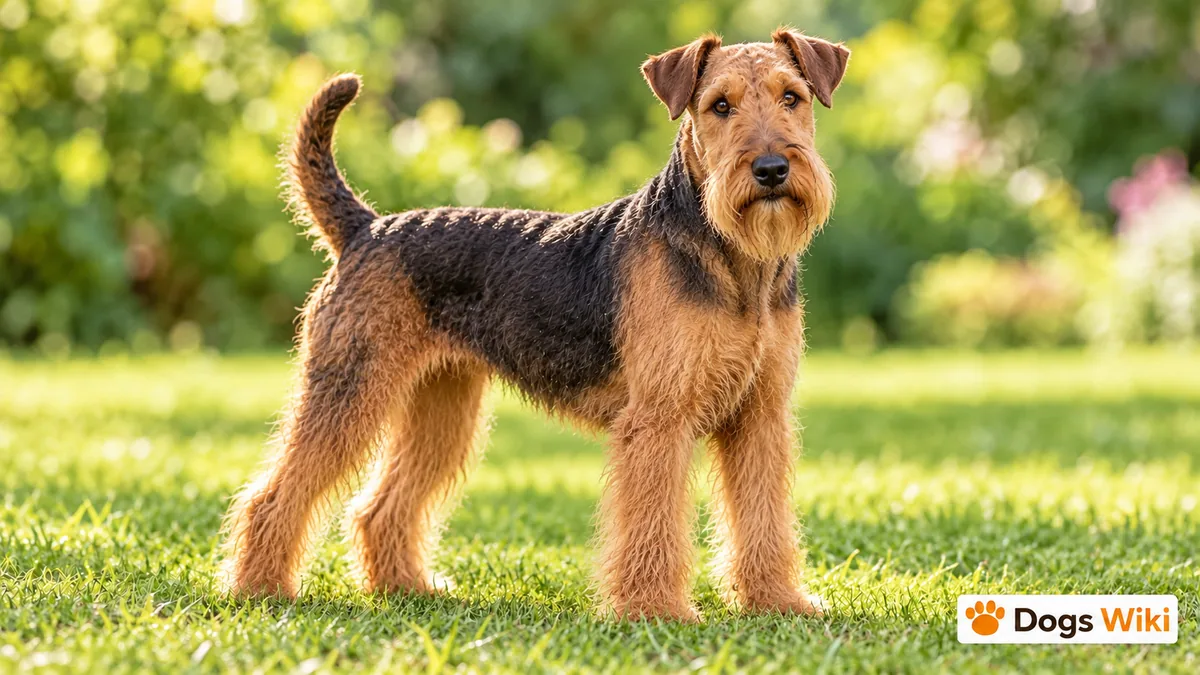
An Airedale Terrier is a large Terrier Group breed developed in the Aire River valley of Yorkshire, England, and nicknamed the King of Terriers for its size and range of working abilities.
An Airedale Terrier is a large Terrier Group breed that developed along England’s Aire River valley in Yorkshire, likely a cross of the Otterhound with local terriers, producing an all-round working dog nicknamed the “King of Terriers” for its size and range of abilities. Airedales have worked as hunters, police dogs, and messenger and sentry dogs during both World Wars, and the breed remains among the most capable all-around working terriers today. This guide covers where the breed originated, its temperament, how big Airedale Terriers get, how long they live, the health problems they are prone to, grooming, how much exercise they need, how easy they are to train, what to feed them, the pros and cons of owning one, and what else people ask.
What Is an Airedale Terrier and Where Did the Breed Originate?
An Airedale Terrier belongs to the American Kennel Club’s Terrier Group and is the largest breed in that group. The breed developed in Yorkshire’s Aire River valley, likely from crosses between the Otterhound and the old English Black and Tan Terrier, producing a tough, adaptable working dog. First exhibited in 1864 under several regional names, the breed wasn’t formally called the Airedale until 1879 and was officially recognized in England in 1886. Airedales served extensively during World War I as messenger, sentry, and search dogs, a role the breed’s intelligence and stamina suited well.
The American Kennel Club defines the breed in its “Official Standard of the Airedale Terrier”, approved July 14, 1959, which sets out the size, coat, and temperament an Airedale Terrier should have. As of September 2026, the AKC ranks the Airedale Terrier 64th of 210 breeds in popularity.
What Is an Airedale Terrier’s Temperament Like?
An Airedale Terrier’s temperament is friendly, affectionate, and loyal, forming strong bonds with its family and generally enjoying involvement in household activities. That said, the breed carries a genuine hunting instinct and a strong sense of its own agenda, and Airedales are not passive dogs, doing best with owners who respect and channel those traits rather than expect a naturally deferential companion. The breed can be a suitable fit for multi-pet homes but isn’t always the top choice given its prey drive.
How Big Do Airedale Terriers Get?
Airedale Terriers are the largest of the AKC Terrier Group, with an athletic, substantial build, a level topline, and a dense, wiry double coat, traditionally tan with a black or grizzle saddle.
What Is the Average Airedale Terrier Height and Weight?
| Measure | American Kennel Club figure |
|---|---|
| Height | 23 inches |
| Weight | 50-70 pounds |
| Life expectancy | 11-14 years |
Figures are from the American Kennel Club Airedale Terrier breed profile, retrieved September 2026.
How Long Do Airedale Terriers Live?
Airedale Terriers live 11 to 14 years. Given that cancer is documented as the breed’s leading cause of death, regular veterinary screening and attentiveness to early warning signs matter considerably.
What Health Problems Are Airedale Terriers Prone To?
Airedale Terriers are documented as being at higher risk for the following conditions.
- Cancer. Health surveys consistently identify cancer as the breed’s leading cause of death, accounting for roughly 38 to 40% of deaths in both UK and North American surveys.
- Hip dysplasia. A hereditary condition causing the hip joint to develop loosely; one study found Airedales affected at nearly double the rate of dogs overall.
- Hypothyroidism. Reduced thyroid hormone production, managed with daily medication once diagnosed.
- Cardiac issues. A recognized cause of death in the breed, worth screening for as part of routine veterinary care.
- Urologic conditions. Documented as a notable cause of death in breed health surveys, worth monitoring with regular veterinary checkups.
How Do You Groom an Airedale Terrier?
Airedale Terriers have a dense, wiry double coat that doesn’t shed considerably on its own, but it requires hand-stripping or clipping several times a year, roughly three to four times, to stay in proper condition. Regular brushing between grooming sessions, along with routine nail trims and ear checks, rounds out the care routine for this low-shedding but genuinely maintenance-intensive coat.
How Much Exercise Does an Airedale Terrier Need?
An Airedale Terrier needs substantial daily exercise and plenty of yard space to run and play, reflecting the breed’s working heritage across hunting, guarding, and military service. This isn’t a laid-back breed, and Airedales that don’t get enough activity are prone to barking, chewing, and other destructive behavior out of boredom.
Are Airedale Terriers Easy to Train?
Airedale Terriers learn quickly, which cuts both ways: the breed picks up new commands fast, but it can also latch onto bad habits just as quickly if training isn’t consistent. Firm, positive, varied training started early works best, and given the breed’s size and independent streak, structure matters more here than with a naturally more compliant breed.
What Should You Feed an Airedale Terrier?
Airedale Terriers do well on 1.5 to 2.5 cups of high-quality food daily, adjusted for age, size, and activity level, and fresh water should always be available given the breed’s genuinely active lifestyle. A veterinarian can help set an appropriate feeding plan for an individual dog.
What Are the Pros and Cons of Owning an Airedale Terrier?
Here are the main advantages of owning an Airedale Terrier.
- Friendly, affectionate, loyal temperament
- Adaptable working ability across hunting, guarding, and sport
- Low-shedding coat
- Excellent with children when properly socialized
Here are the main drawbacks of owning an Airedale Terrier.
- Cancer is documented as the breed’s leading cause of death
- Needs substantial daily exercise and yard space
- Coat requires hand-stripping or clipping several times a year
- Independent streak means training needs real consistency
Airedale Terrier rescue organizations place adult dogs, though the breed’s relative rarity can limit availability, worth a look for anyone drawn to the breed’s versatility and loyalty but not set on a breeder search.
What Else Do People Ask About the Airedale Terrier?
The questions below cover how much an Airedale Terrier costs, whether Airedale Terriers are good family dogs, why the Airedale Terrier is called the “King of Terriers”, and whether Airedale Terriers shed a lot.
How much does an Airedale Terrier cost?
Airedale Terrier prices run from around $800 to $1,800 from a reputable breeder who provides OFA hip and thyroid clearance, though prices vary by region and bloodline. Adopting an adult Airedale through a rescue is usually a lower-cost alternative, though the breed’s relative rarity can limit availability.
Are Airedale Terriers good family dogs?
Yes, Airedale Terriers are generally excellent family dogs, known for being friendly, affectionate, and patient with children. Their size, strength, and independent streak mean consistent training and socialization matter more with this breed than with smaller, more naturally compliant ones.
Why is the Airedale Terrier called the “King of Terriers”?
The Airedale Terrier earned the nickname “King of Terriers” for being the largest breed in the AKC Terrier Group, combined with a genuinely adaptable working history spanning hunting, guarding, police work, and military service during both World Wars. That combination of size and all-around capability set it apart from smaller, more specialized terrier breeds.
Do Airedale Terriers shed a lot?
No, Airedale Terriers are low shedders thanks to their dense, wiry coat, but that same coat requires hand-stripping or clipping several times a year to stay in good condition. The low shedding comes at the cost of a genuinely higher grooming time commitment than a typical short-coated breed.
Related Guides
More guides on The Dogs Wiki cover behavior, health, grooming, training, nutrition, and adoption.
| Guide |
|---|
| Behavior |
| Health |
| Grooming |
| Training |
| Nutrition |
| Adoption |