Urinary incontinence in dogs is the involuntary leaking of urine, distinct from a house-training problem, most commonly caused by weakened bladder sphincter muscles in spayed female dogs.
Incontinence is a genuine medical condition rather than a behavioral issue, since an incontinent dog has no control over the leaking and is often unaware it’s happening, particularly during sleep. This guide covers what causes urinary incontinence, its symptoms, how it’s diagnosed, how it’s treated, whether it can be prevented, and when to see a veterinarian.
This guide covers what urinary incontinence is, what causes it in dogs, its symptoms, how it’s diagnosed, how it’s treated, whether it can be prevented, when to see a vet, and what else people ask.
What Is Urinary Incontinence in Dogs?
Urinary incontinence in dogs is the involuntary leaking of urine, meaning the dog has no conscious control over it, as opposed to voluntary urination in an inappropriate place, which is a behavioral or house-training issue rather than a medical one. The most commonly diagnosed form is urethral sphincter mechanism incompetence, in which the muscle responsible for keeping the bladder closed weakens and allows urine to leak out, particularly while a dog is relaxed or sleeping. This specific form is especially common in spayed female dogs, since the procedure is associated with hormonal changes that can affect sphincter muscle tone over time.
What Causes Urinary Incontinence in Dogs?
Urethral sphincter mechanism incompetence, linked to reduced estrogen levels following spay surgery, is the most common cause of incontinence in female dogs, though the exact reason only some spayed females develop the condition isn’t fully understood. Neurological conditions affecting the nerves that control bladder function, anatomical abnormalities present from birth, and bladder stones or chronic urinary tract infections can all also cause or contribute to incontinence. Age-related weakening of the muscles involved in bladder control is another recognized contributing factor, particularly in senior dogs.
What Are the Symptoms of Urinary Incontinence in Dogs?
The hallmark symptom of urinary incontinence is leaking urine without the dog’s awareness, most often noticed as wet spots where a dog has been lying down or sleeping. Some dogs show mild dribbling throughout the day, while others primarily leak during sleep when the muscles controlling the bladder are most relaxed. Unlike a UTI, incontinence typically doesn’t cause straining, pain, or visible discomfort during urination, since the leaking happens passively rather than during an active attempt to urinate.
How Is Urinary Incontinence in Dogs Diagnosed?
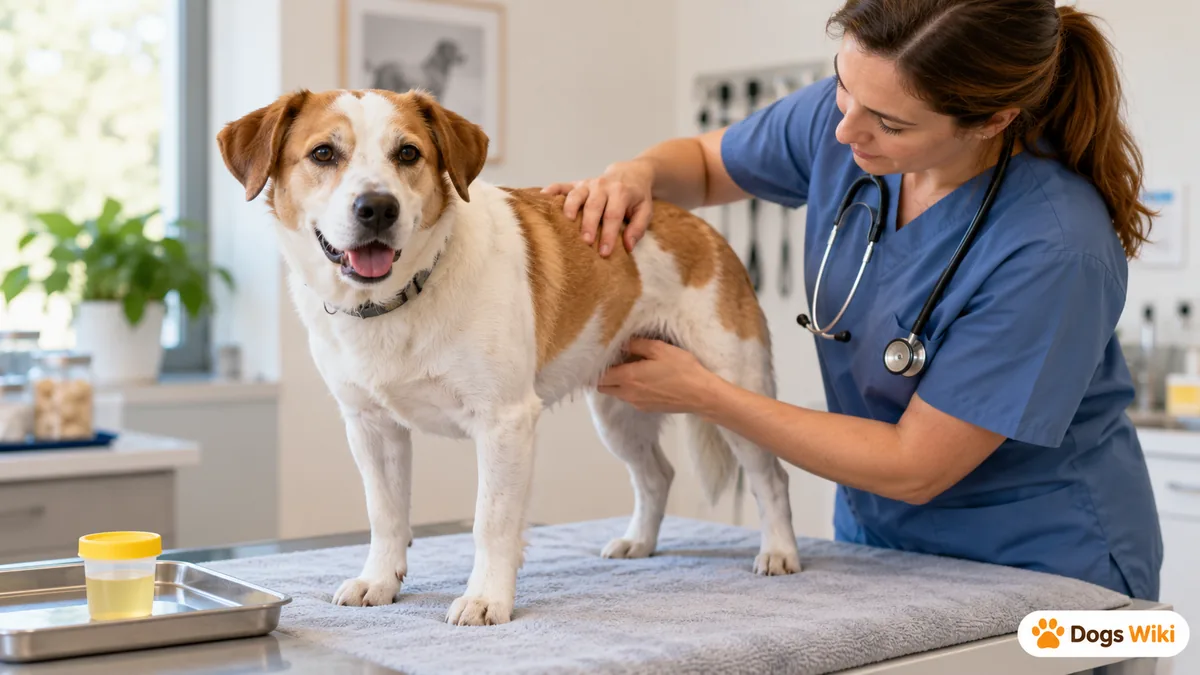
A veterinarian diagnosing incontinence first rules out a urinary tract infection and other active urinary conditions through a urinalysis, since these need to be addressed separately and can sometimes mimic or worsen incontinence symptoms. Bloodwork and a physical exam help assess for other contributing conditions, and in cases where a structural or neurological cause is suspected, imaging such as an X-ray or ultrasound can help identify an anatomical abnormality. A thorough history, including when the leaking happens and how it started, also helps a veterinarian narrow down the likely cause.
How Is Urinary Incontinence in Dogs Treated?
Urethral sphincter mechanism incompetence is commonly treated with medication that helps strengthen the sphincter muscle’s tone, most often a drug called phenylpropanolamine, which many dogs respond well to with significantly reduced or resolved leaking. For dogs where hormone-related changes are the primary driver, a veterinarian may also consider hormone replacement therapy as an alternative or complementary approach. Incontinence caused by a structural abnormality sometimes requires surgical correction, while incontinence secondary to another condition, like bladder stones, improves once that underlying issue is properly treated.
Can Urinary Incontinence in Dogs Be Prevented?
Urethral sphincter mechanism incompetence following spay surgery isn’t entirely preventable, since it’s a recognized, though unpredictable, potential effect of the hormonal changes involved, and it affects only a portion of spayed female dogs. Promptly treating urinary tract infections and bladder stones can prevent the incontinence that sometimes develops as a complication of those conditions. For dogs that do develop incontinence, early diagnosis and treatment considerably improve the chances of good symptom control.
When Should You See a Vet for Urinary Incontinence in Dogs?
See a veterinarian if a dog starts leaking urine involuntarily, particularly if this is a new change in a previously reliably house-trained dog, since this is worth investigating as a medical issue rather than a training lapse. It’s especially worth a prompt visit if the leaking is accompanied by straining, pain, or blood in the urine, since these additional symptoms suggest a different or coexisting urinary problem needing its own evaluation. A dog already diagnosed with incontinence should see a veterinarian if the leaking changes in frequency or severity, since the treatment plan may need adjustment.
What Else Do People Ask About Urinary Incontinence in Dogs?
The questions below cover whether incontinence is the dog’s fault, whether it’s treatable, which dogs are most at risk, and whether incontinence always requires lifelong medication.
Is urinary incontinence a behavioral problem the dog can control?
No, true urinary incontinence is not a behavioral problem, and an affected dog has no conscious control over the leaking, which typically happens during sleep or relaxation without the dog’s awareness. Punishing a dog for incontinence doesn’t help and isn’t appropriate, since the dog isn’t choosing to leak urine.
Is urinary incontinence in dogs treatable?
Yes, urinary incontinence is often very treatable, particularly urethral sphincter mechanism incompetence, which responds well to medication in many dogs. The right treatment depends on the underlying cause, which is why an accurate diagnosis matters before starting any specific treatment.
Which dogs are most at risk for urinary incontinence?
Spayed female dogs face the highest documented risk for urethral sphincter mechanism incompetence, with larger breeds showing a somewhat higher reported rate than smaller breeds in some studies. Senior dogs of either sex also face an elevated risk of age-related incontinence as bladder control muscles naturally weaken over time.
Does incontinence always require lifelong medication?
Not always, since incontinence caused by a treatable underlying condition, like a UTI or bladder stones, typically resolves once that condition is addressed. Incontinence from urethral sphincter mechanism incompetence, however, often does require ongoing medication to manage symptoms long-term, since the underlying muscle weakness doesn’t resolve on its own.
Related Guides
More guides on The Dogs Wiki cover general dog health and senior dog care.
| Guide |
|---|
| Dog Health |