
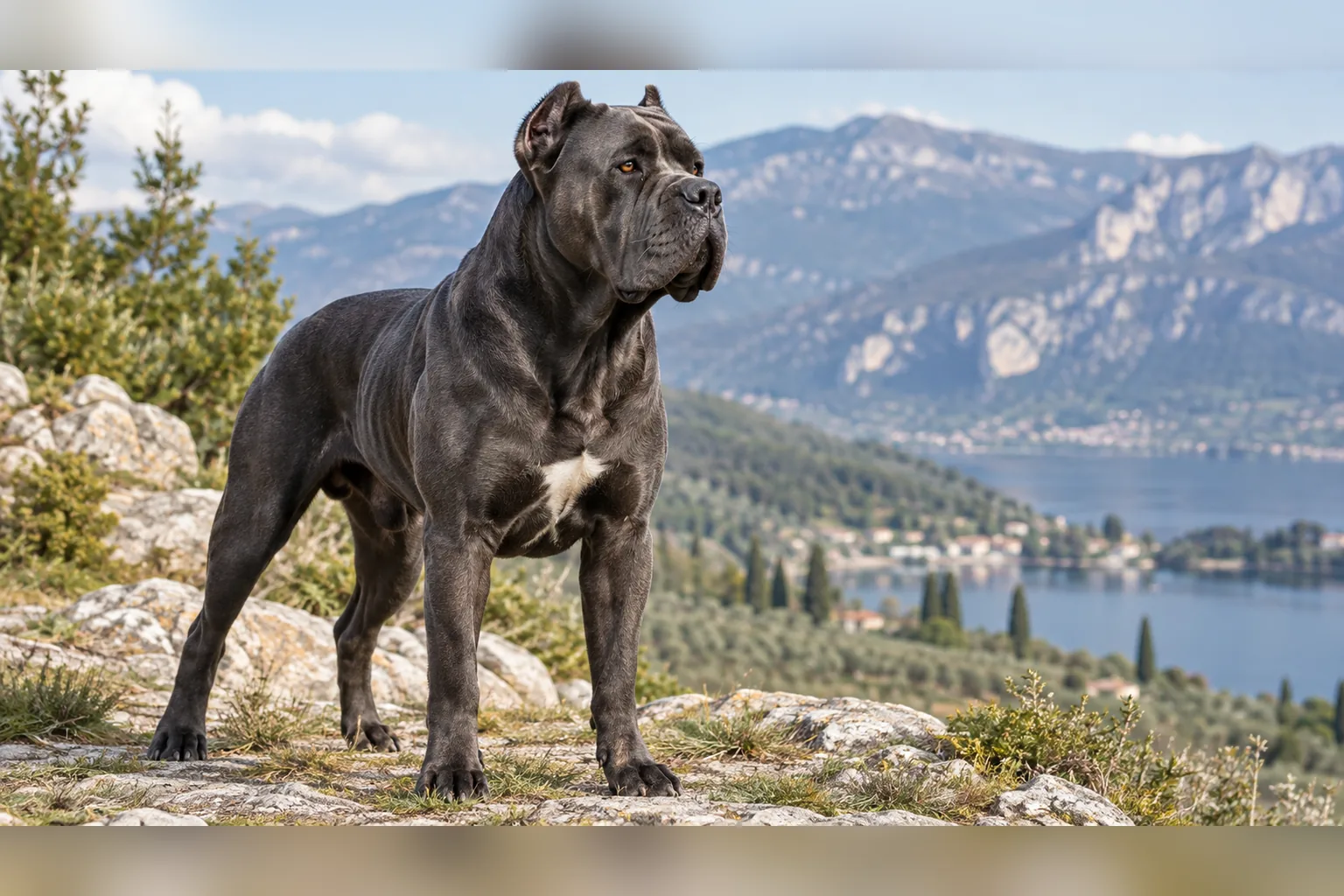
Home → Dog Breeds → Guardian/LGD & Molosser → Cane Corso Guardian Traits
Cane Corso Guardian Traits: What Makes This Breed a Natural Protector
The Cane Corso’s guardian instinct is among the most defining, and most misunderstood, traits of the breed, rooted in centuries of work as a Roman farmyard and property protector.
This page covers where the Cane Corso’s guardian instinct comes from, how a Cane Corso protects its family, and what else people ask. For general information on the breed’s size, health, grooming, and diet, see the full Cane Corso breed profile, which this page intentionally doesn’t repeat.
Where Does the Cane Corso’s Guardian Instinct Come From?
The Cane Corso’s guardian instinct traces back to the ancient Roman Molossian war dogs, prized for strength, courage, and loyalty, and to the breed’s later role protecting Italian farms and property. The breed’s name is thought to come from the Latin word “cohors,” translating roughly to “protector” or “guardian of the farmyard,” a role the Cane Corso filled for centuries before nearly going extinct as Italian farming mechanized in the 20th century. Enthusiasts revived the breed in the 1970s, preserving that same guarding temperament in the dog recognized by the AKC in 2010.
The guardian role is written into the AKC’s “Official Standard of the Cane Corso”, approved October 20, 2009, and current breed details are on the American Kennel Club Cane Corso breed page, retrieved September 2026.
How Does a Cane Corso Protect Its Family?
A Cane Corso’s protective behavior typically shows up as heightened territorial awareness, genuine watchfulness around the property, and a physical presence that can include positioning itself between its family and a perceived threat. The breed is reserved to indifferent with strangers by design, a trait that’s genuinely part of effective guarding rather than a flaw, though it means a Cane Corso won’t warm up to visitors the way a more universally friendly breed might. This watchfulness is a deliberate, bred-in trait rather than fearfulness or poor socialization on its own.
What Else Do People Ask About the Cane Corso Guardian Traits?
The questions below cover whether Cane Corsos make good guard dogs, at what age a Cane Corso’s protectives instinct develop, whether the Cane Corso is or the Boerboel the better guardian breed, and whether Cane Corsos need special guardian-dog training.
Do Cane Corsos make good guard dogs?
Yes, Cane Corsos make excellent natural guard dogs, drawing on centuries of breeding specifically for property and family protection, and the breed’s size, confidence, and watchfulness make it a genuinely effective deterrent. That effectiveness depends entirely on proper training and socialization; an unmanaged Cane Corso’s guarding instinct can become a liability rather than an asset.
At what age does a Cane Corso’s protective instinct develop?
A Cane Corso’s protective instincts typically become more apparent as the dog matures into adolescence and adulthood, generally becoming more pronounced sometime after the first year, though exact timing varies by individual dog. Early socialization during puppyhood, well before this instinct fully develops, is what determines whether that protectiveness matures into balanced, well-managed watchfulness or genuine over-guarding.
Is the Cane Corso or the Boerboel the better guardian breed?
Cane Corsos and Boerboels are both formidable natural guardians, but they differ in size and intensity: Boerboels run considerably larger and heavier, while Cane Corsos are somewhat more agile and commonly used in structured protection sports. Both breeds require extensive socialization and an experienced handler, and “better” depends on the specific guarding role, property size, and owner experience level involved. See our full Boerboel guide for more detail.
Do Cane Corsos need special guardian-dog training?
Yes, Cane Corsos benefit considerably from structured, early socialization specifically aimed at channeling their guardian instincts appropriately, ideally working with a professional trainer experienced in guardian breeds. General obedience training alone isn’t enough for this breed; the guarding instinct needs deliberate, consistent management from puppyhood to develop into safe, well-calibrated protectiveness rather than problem behavior.
Related Guides
More guides on The Dogs Wiki cover Cane Corso, behavior, and boerboel.
| Guide |
|---|
| Cane Corso |
| Behavior |
| Boerboel |
Leave a Reply