Home → Dog Breeds → Herding Group → Australian Shepherd
An Australian Shepherd is a medium-sized Herding Group breed that, despite its name, was developed in the western United States for ranch and farm work, with the “Australian” label widely considered a historical misnomer.
The breed became associated with the American West after World War II thanks to Western movies and rodeo appearances, and today’s Aussie remains a genuinely tireless working dog whether on a ranch or in a suburban backyard. This guide covers where the breed originated, its temperament, how big Australian Shepherds get, how long they live, the health problems they are prone to, grooming, how much exercise they need, how easy they are to train, what to feed them, the pros and cons of owning one, and what else people ask.
What Is an Australian Shepherd and Where Did the Breed Originate?
An Australian Shepherd belongs to the American Kennel Club’s Herding Group. Despite its name, the breed developed in the western United States, shaped entirely by function for ranch and farm work rather than fashion. The Aussie became valued and visible in the American West for its exceptional herding ability and constant alertness, gaining broader public attention after World War II through Western films and rodeo appearances. Official AKC recognition came in 1991.
The American Kennel Club defines the breed in its “Official Standard of the Australian Shepherd”, approved May 14, 1991, which sets out the size, coat, and temperament an Australian Shepherd should have. As of September 2026, the AKC ranks the Australian Shepherd 12th of 210 breeds in popularity.
Why Is It Called an Australian Shepherd?
Nobody knows for certain. One popular explanation holds that the ancestors of the breed arrived in the American West with Basque shepherds who had worked sheep in Australia, and that ranchers named the dogs after the flocks they came with. Another view holds that “Australian” simply described any blue merle dog imported alongside Australian sheep. Either way, the breed as it exists today was built on American ranches, and Australia has no native breed by that name.
What Is an Australian Shepherd’s Temperament Like?
An Australian Shepherd’s temperament is intelligent, energetic, and loyal, with a strong work ethic that remains intact even generations removed from actual ranch work. The standard describes a dog that is “good natured, seldom quarrelsome” and “may be somewhat reserved in initial meetings.” Aussies are eager to please and highly trainable, protective of their family and territory given their herding heritage, which makes them effective watchdogs. That same herding instinct means Aussies may attempt to herd children, other pets, or even moving vehicles without proper training to redirect the behavior.
Do Australian Shepherds Get Separation Anxiety?
Many do. Aussies are sometimes called “Velcro dogs” because they follow their person from room to room, and a dog bred to work beside a rancher all day can struggle when left alone for eight hours. Pacing, chewing, and barking when the family leaves are the common signs. Building up time alone gradually, and giving a long walk and a puzzle toy before departures, helps most dogs settle. A dog walker or daycare suits families who work long days away from home.
How Big Do Australian Shepherds Get?
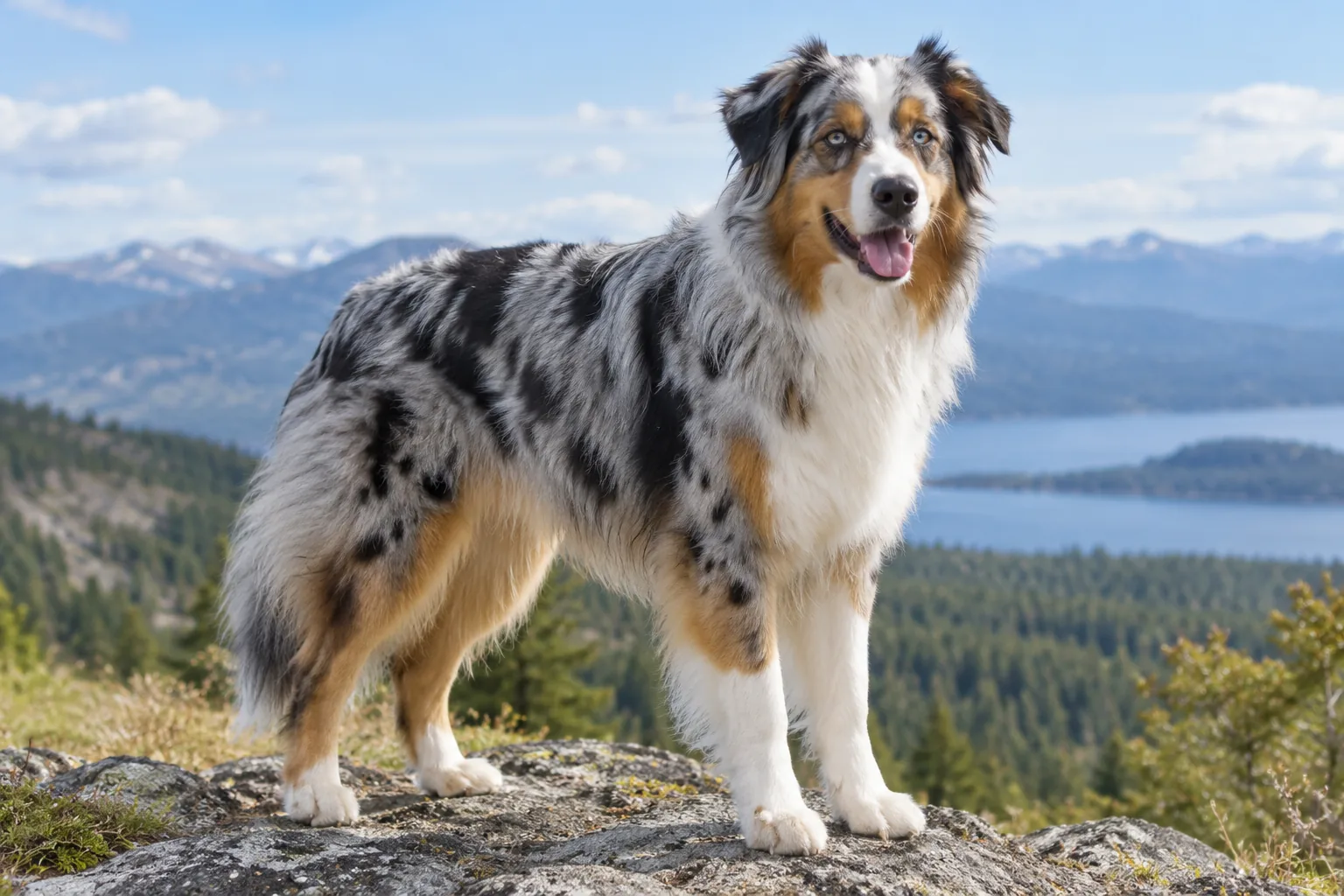
Australian Shepherds are a medium-sized, athletic breed with a medium-length, straight to wavy coat, feathering on the legs, and a range of striking coat colors and patterns, including merle. Four colors appear in the standard with no order of preference: blue merle, black, red merle, and red, each with or without white markings and copper points. Many Aussies are born with a natural bobtail, while others have full tails.
What Is the Average Australian Shepherd Height and Weight?
| Measure | American Kennel Club figure |
|---|---|
| Height | 20-23 inches (male), 18-21 inches (female) |
| Weight | 50-65 pounds (male), 40-55 pounds (female) |
| Life expectancy | 12-15 years |
Figures are from the American Kennel Club Australian Shepherd breed profile, retrieved September 2026.
How Long Do Australian Shepherds Live?
Australian Shepherds live 12 to 15 years. Regular veterinary care, including awareness of the breed’s documented drug sensitivity covered below, supports a full lifespan.
What Health Problems Are Australian Shepherds Prone To?
Australian Shepherds are documented as being at higher risk for the following conditions.
What Is the MDR1 Gene Mutation in Australian Shepherds?
The MDR1, or ABCB1, mutation is a drug sensitivity found at high prevalence in the breed; roughly half of Australian Shepherds carry at least one copy. Normally the gene pumps certain drugs out of the brain. Dogs with the mutation can suffer severe, potentially fatal reactions to medications such as ivermectin at high doses, loperamide, acepromazine, and some chemotherapy drugs. A cheek-swab test shows whether a dog is normal, a carrier, or affected, and the result belongs in the dog’s veterinary file.
What Is Hip and Elbow Dysplasia in Australian Shepherds?
Hip and elbow dysplasia are joint conditions where the bones don’t fit together properly, causing pain and lameness, which is important to manage given the breed’s high activity level. Stiffness after exercise and a reluctance to jump are early signs. OFA or PennHIP screening of both parents lowers the odds, and keeping a working dog lean protects its joints for life.
What Eye Problems Affect Australian Shepherds?
Hereditary cataracts, a clouding of the lens that can appear in young dogs, are among the most common eye problems in the breed, and a DNA test for the HSF4 mutation identifies at-risk dogs. Collie eye anomaly and progressive retinal atrophy also occur and have DNA tests. Iris coloboma, in which the iris fails to develop fully, causes light sensitivity and is more common in Australian Shepherds than most breeds.
Why Is Merle-to-Merle Breeding Risky in Australian Shepherds?
Breeding two merle dogs together means about a quarter of the puppies inherit two copies of the merle gene. These “double merles” are mostly white and are frequently born deaf, blind, or with malformed eyes. Responsible breeders pair a merle with a solid-colored dog, which produces merle puppies without the double merle risk.
What Other Health Problems Affect Australian Shepherds?
Idiopathic epilepsy, a seizure disorder with no identifiable underlying cause, is managed with lifelong medication once diagnosed. Hypothyroidism occurs and is treated with a daily tablet. Cancer, including hemangiosarcoma and lymphoma, is a recognized health concern in the breed and worth discussing with a veterinarian as part of routine preventive care.
How Do You Groom an Australian Shepherd?
Australian Shepherds have a thick double coat that sheds moderately to heavily year-round, with two heavier seasonal blowouts, and brushing multiple times a week keeps the volume of loose hair under control. A slicker brush and undercoat rake both help during the heaviest shedding periods, and the breed is not considered hypoallergenic.
| Grooming task | How often |
|---|---|
| Brush with a slicker brush and undercoat rake | Two to three times a week, daily during a blowout |
| Comb out the feathering behind the ears and on the legs | Weekly |
| Trim hair between the paw pads | Monthly |
| Trim nails | Every 3 to 4 weeks |
| Bath | Every 1 to 3 months |
Avoid shaving an Aussie. The double coat protects against sun and heat, and a shaved coat can grow back patchy.
How Much Exercise Does an Australian Shepherd Need?
An Australian Shepherd needs substantial daily exercise and consistent mental engagement, reflecting the breed’s history working livestock all day on a ranch. Aussies do well at agility, herding trials, and other dog sports, and under-stimulated dogs are prone to developing unsavory behaviors, since the breed’s need for a job doesn’t fade just because it lives as a companion.
How Much Exercise Does an Australian Shepherd Need Each Day?
Plan on at least one to two hours of activity a day for a healthy adult, mixing running or hiking with training and games that make the dog think. Fetch, flying disc, herding lessons, and agility classes all suit the breed. Puppies need shorter sessions and no long runs until their growth plates close at around a year to 18 months. Mental work counts: fifteen minutes of trick training can tire an Aussie as much as a long walk.
Are Australian Shepherds Easy to Train?
Yes, Australian Shepherds are highly intelligent and among the most trainable breeds, and they compete successfully in obedience, agility, herding trials, and other structured dog sports. Consistent, varied training matters, since Aussies need ongoing mental challenges, and the breed can develop unwanted habits quickly when training isn’t consistent from the start.
How Do You Stop an Australian Shepherd From Herding Children?
Nipping at heels and circling running children is instinct, not aggression, but it still needs to stop. Redirect the dog to a toy the moment it starts to stalk, and reward it for lying down while kids play. Teach children to stand still rather than run and shriek, which only fuels the chase. Herding lessons with real sheep give the instinct a proper outlet.
What Should You Feed an Australian Shepherd?
Australian Shepherds do well on a high-quality formula suited to their age and high activity level, and a veterinarian can help determine appropriate portions based on the individual dog’s actual work or exercise load.
How Many Meals a Day Does an Australian Shepherd Need?
Puppies eat three meals a day until around six months, then move to two. Adults stay on two measured meals. A working ranch dog can need much more food than a family pet of the same weight, so portions should follow body condition: ribs easy to feel, and a clear waist when viewed from above. Treats used in training count toward the day’s total.
What Are the Pros and Cons of Owning an Australian Shepherd?
Here are the main advantages and drawbacks of owning an Australian Shepherd, side by side.
| Pros | Cons |
|---|---|
| Highly intelligent, loyal, eager-to-please temperament | Needs substantial daily exercise and mental engagement |
| Excellent watchdog given natural protectiveness | Documented high prevalence of the MDR1 drug sensitivity mutation |
| Does well at agility, herding trials, and other dog sports | Heavy shedding with two intense seasonal blowouts |
| Capable across work, sport, and companionship | Herding instinct can lead to nipping or chasing without proper training |
People who admire the breed’s intelligence and loyalty but would rather not search for a breeder can contact Australian Shepherd rescue organizations, which place adult dogs regularly.
What Else Do People Ask About the Australian Shepherd?
The questions below cover the price of an Australian Shepherd, whether a family home is a good fit, what the MDR1 mutation in Australian Shepherds is, and whether the Miniature American Shepherd is the same as a small Australian Shepherd.
What is the price of an Australian Shepherd?
Australian Shepherd prices vary by region, bloodline, and breeder reputation, and a puppy from a breeder who screens for hip, elbow, and eye health, along with MDR1 testing, costs more than one that doesn’t. Adopting an adult Australian Shepherd through a rescue is a lower-cost alternative.
Is a family home a good fit for an Australian Shepherd?
Yes, Australian Shepherds can be excellent family dogs for active households, thanks to a loyal, protective temperament that extends well to children. Families should be prepared to manage the breed’s herding instinct, which can show up as gentle nipping or chasing without consistent early training.
What is the MDR1 mutation in Australian Shepherds?
The MDR1, or ABCB1, mutation is a genetic drug sensitivity found at high prevalence in Australian Shepherds, which can cause severe, potentially fatal reactions to certain common medications, including some parasite preventives and anesthesia drugs. A simple genetic test can identify whether an individual dog carries the mutation, which is important information to share with any veterinarian treating the dog.
Is the Miniature American Shepherd the same as a small Australian Shepherd?
No, despite looking like a smaller Aussie, the Miniature American Shepherd is a separate AKC-recognized breed with its own conformation standard, not simply a small Australian Shepherd. The two breeds share a similar temperament and health considerations, including the MDR1 mutation, but they are registered and judged as separate breeds.
Related Guides
More guides on The Dogs Wiki cover behavior, health, grooming, training, nutrition, and adoption.
| Guide |
|---|
| Behavior |
| Health |
| Grooming |
| Training |
| Nutrition |
| Adoption |