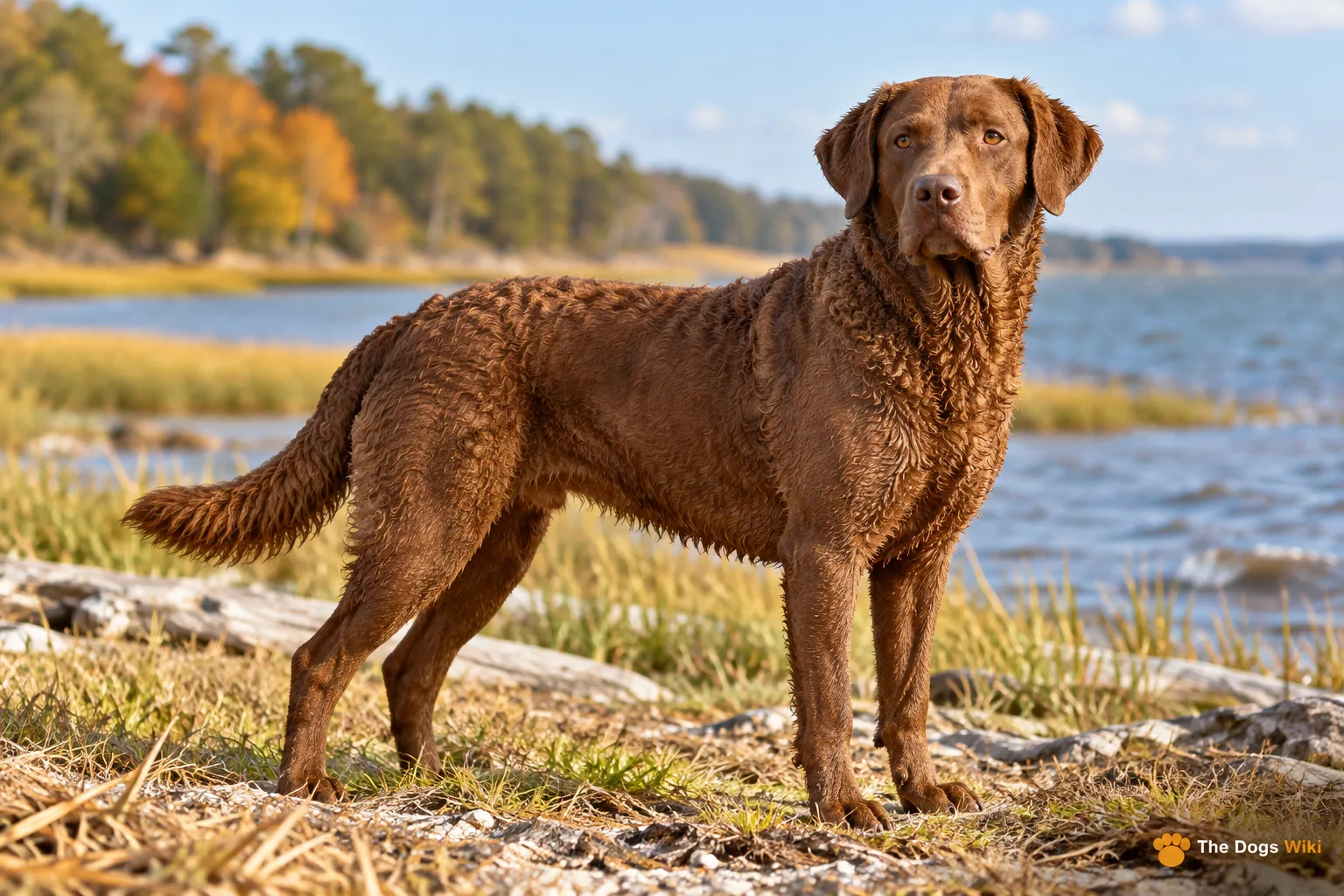
A Chesapeake Bay Retriever is a large Sporting Group breed developed in 19th-century Maryland to retrieve waterfowl from the cold, rough waters of the Chesapeake Bay.
A Chesapeake Bay Retriever is a large Sporting Group breed developed in 19th-century Maryland to retrieve waterfowl from the cold, rough waters of the Chesapeake Bay, a job so demanding it shaped one of the toughest, most weather-resistant coats of any retriever breed. Officially the state dog of Maryland, the Chessie remains less common than its Labrador and Golden cousins but is prized by enthusiasts for its endurance and independent-minded intelligence. This guide covers where the breed originated, its temperament, how big Chesapeake Bay Retrievers get, how long they live, the health problems they are prone to, grooming, how much exercise they need, how easy they are to train, what to feed them, the pros and cons of owning one, and what else people ask.
What Is a Chesapeake Bay Retriever and Where Did the Breed Originate?
A Chesapeake Bay Retriever belongs to the American Kennel Club’s Sporting Group. The breed developed in 19th-century Maryland from dogs bred specifically to retrieve ducks from the Chesapeake Bay’s cold, choppy waters, sometimes hauling in hundreds of birds in a single day for market hunters. That extreme working demand shaped the breed’s oily, water-resistant double coat and powerful, deep-chested build. The AKC recognized the breed in 1885, and it remains the official state dog of Maryland.
The American Kennel Club defines the breed in its “Official Standard for the Chesapeake Bay Retriever”, approved November 9, 1993, which sets out the size, coat, and temperament a Chesapeake Bay Retriever should have. As of September 2026, the AKC ranks the Chesapeake Bay Retriever 52nd of 210 breeds in popularity.
What Is a Chesapeake Bay Retriever’s Temperament Like?
A Chesapeake Bay Retriever’s temperament is loyal, upbeat, and affectionate, paired with an independent, strong-willed streak that sets it apart from more universally eager-to-please retrievers. Chessies are protective of their family and home, intelligent, and genuinely tireless workers, traits that made them prized as both hunting dogs and, historically, service dogs. That independence means the breed sometimes shows a more serious or reserved side than a Labrador or Golden Retriever, and it does best with owners who provide firm, consistent leadership rather than a purely permissive approach.
How Big Do Chesapeake Bay Retrievers Get?
Chesapeake Bay Retrievers are a large, well-boned, powerfully built breed with a broad, deep chest built for strength in rough water. A distinctive breed trait is that the hindquarters sit as high as, or higher than, the shoulders, giving the dog a slightly different silhouette than most other retrievers.
What Is the Average Chesapeake Bay Retriever Height and Weight?
| Measure | American Kennel Club figure |
|---|---|
| Height | 23-26 inches (male), 21-24 inches (female) |
| Weight | 65-80 pounds (male), 55-70 pounds (female) |
| Life expectancy | 10-13 years |
Figures are from the American Kennel Club Chesapeake Bay Retriever breed profile, retrieved September 2026.
How Long Do Chesapeake Bay Retrievers Live?
Chesapeake Bay Retrievers live 10 to 13 years, though some breed surveys report a wider range depending on the study. Regular veterinary care, consistent weight management, and attention to the joint and eye conditions covered below all support a full, active lifespan for this sturdy breed.
What Health Problems Are Chesapeake Bay Retrievers Prone To?
Chesapeake Bay Retrievers are documented as being at higher risk for the following conditions.
- Hip and elbow dysplasia. Malformations of the joint that cause pain and early arthritis, screened for with OFA hip and elbow evaluations in reputable breeding programs.
- Progressive retinal atrophy and hereditary cataracts. Inherited eye conditions that can affect vision over time; DNA and eye screening help identify carriers before breeding.
- Degenerative myelopathy. A progressive spinal cord disease causing hind-leg weakness and eventual paralysis; the Chesapeake Bay Retriever is one of the breeds more commonly affected.
- Exercise-induced collapse (EIC). A genetic condition causing weakness or collapse after intense exercise or excitement; a DNA test is available to screen for it.
- Von Willebrand’s disease. An inherited bleeding disorder that affects the blood’s ability to clot properly, identified through genetic testing.
How Do You Groom a Chesapeake Bay Retriever?
Chesapeake Bay Retrievers have a short, wavy, water-resistant double coat with a fine, wooly undercoat that holds natural oils to protect the dog during cold-water retrieving. The coat needs only occasional brushing to manage shedding and distribute those protective oils, making it relatively low-maintenance for a working retriever breed. Regular nail trims and dental care round out the grooming routine, and because the coat is naturally oily, over-bathing can strip away the protection that makes it useful in water.
How Much Exercise Does a Chesapeake Bay Retriever Need?
A Chesapeake Bay Retriever needs substantial daily exercise, reflecting the breed’s history as a tireless working water retriever capable of hunting all day in harsh conditions. Swimming and retrieving games are a natural fit given the breed’s history, and a Chessie that isn’t getting enough physical and mental engagement can become restless or willful, in particular given the breed’s independent streak.
Are Chesapeake Bay Retrievers Easy to Train?
Chesapeake Bay Retrievers are intelligent but independent-minded, which means training generally takes more consistency and firmness than with a more naturally compliant retriever breed. Structured, consistent training that provides real mental stimulation tends to get the best results, since Chessies are smart enough to get bored with repetitive, low-challenge sessions.
What Should You Feed a Chesapeake Bay Retriever?
Chesapeake Bay Retrievers do well on a large-breed formula suited to their age and activity level, and maintaining an ideal body weight is important for this breed since excess weight worsens the joint problems the breed is already prone to. Measured feeding and controlled treats, factored into the dog’s overall daily calories, help keep weight in a healthy range.
What Are the Pros and Cons of Owning a Chesapeake Bay Retriever?
Here are the main advantages of owning a Chesapeake Bay Retriever.
- Loyal, protective, and deeply devoted to family
- Tireless working ability and strong swimming instincts
- Relatively low-maintenance coat despite its water-resistant design
- Well suited to active owners, those near water
Here are the main drawbacks of owning a Chesapeake Bay Retriever.
- Independent, strong-willed temperament needs firm, consistent handling
- Documented risk of degenerative myelopathy, a serious spinal condition
- Needs substantial daily exercise to stay physically and mentally satisfied
- Less universally easygoing with strangers than some other retriever breeds
Chesapeake Bay Retriever rescue organizations place adult dogs, though the breed’s relative rarity means availability can be more limited than with more common retrievers, worth a look for anyone drawn to the breed’s independence and working drive but not set on a breeder search.
What Else Do People Ask About the Chesapeake Bay Retriever?
The questions below cover how much a Chesapeake Bay Retriever costs, whether Chesapeake Bay Retrievers are good family dogs, the difference between the Chesapeake Bay Retriever and the Labrador Retriever, what degenerative myelopathy in Chesapeake Bay Retrievers is, and whether Chesapeake Bay Retrievers shed a lot.
How much does a Chesapeake Bay Retriever cost?
Chesapeake Bay Retriever prices range from around $1,000 to $2,500 from a reputable breeder who screens for hip, elbow, and eye conditions, and the breed’s relative rarity compared to Labradors and Golden Retrievers means waiting lists are common. Adopting an adult Chessie through a rescue is usually a lower-cost alternative, though availability can be limited given the breed’s smaller population.
Are Chesapeake Bay Retrievers good family dogs?
Chesapeake Bay Retrievers can be good family dogs, in particular for experienced owners, thanks to a loyal, protective temperament. Their independent streak and reserved nature with strangers mean they generally need more structured training and socialization than a Labrador or Golden Retriever to reach their full potential as a family companion.
What Is the Difference Between the Chesapeake Bay Retriever and the Labrador Retriever?
Chesapeake Bay Retrievers and Labrador Retrievers are both water-loving retriever breeds from the Sporting Group, but they differ meaningfully in temperament and coat. Chessies have a more independent, protective personality and a distinctive wavy, oily coat built for icy water, while Labradors are generally more universally friendly and food-motivated with a shorter, denser coat.
What is degenerative myelopathy in Chesapeake Bay Retrievers?
Degenerative myelopathy is a progressive disease of the spinal cord that gradually weakens the hind legs and eventually leads to paralysis, and the Chesapeake Bay Retriever is one of the breeds more commonly affected by it. There’s no cure, but physical therapy and mobility support can help manage the condition and maintain quality of life after diagnosis.
Do Chesapeake Bay Retrievers shed a lot?
Yes, Chesapeake Bay Retrievers shed, though the breed’s short, wavy coat is relatively easy to manage with occasional brushing compared to longer-coated retriever breeds. Regular brushing helps keep loose hair under control and distributes the coat’s natural protective oils.
Related Guides
More guides on The Dogs Wiki cover health, grooming, behavior, training, nutrition, and adoption.
| Guide |
|---|
| Health |
| Grooming |
| Behavior |
| Training |
| Nutrition |
| Adoption |