A Curly-Coated Retriever is a large Sporting Group breed believed to be the oldest of all the retriever breeds, developed in England from a mix that likely included the now-extinct Old English Water Spaniel, the old-style Retrieving Setter, the St.
John’s Newfoundland, and possibly the Poodle. The breed’s tight, crisp curls, unlike any other retriever’s coat, were bred specifically to protect against thick bramble and icy water. This guide covers where the breed originated, its temperament, how big Curly-Coated Retrievers get, how long they live, the health problems they are prone to, grooming, how much exercise they need, how easy they are to train, what to feed them, the pros and cons of owning one, and what else people ask.
What Is a Curly-Coated Retriever and Where Did the Breed Originate?
A Curly-Coated Retriever belongs to the American Kennel Club’s Sporting Group and is widely believed to be the oldest of the retriever breeds. The AKC’s official breed standard describes the Curly as “self-confident, steadfast and proud,” and the breed was a favorite among English gamekeepers for its hunting prowess and agility. The Curly-Coated Retriever was first registered with the AKC in 1924, and the Curly-Coated Retriever Club of America was founded in 1979. Along with the Flat-Coated Retriever, the Curly was one of the first two retriever breeds established, originally recognized in England as early as 1860.
The American Kennel Club defines the breed in its “Official Standard for the Curly-Coated Retriever”, approved October 12, 1993, which sets out the size, coat, and temperament a Curly-Coated Retriever should have. As of September 2026, the AKC ranks the Curly-Coated Retriever 163rd of 210 breeds in popularity.
What Is a Curly-Coated Retriever’s Temperament Like?
A Curly-Coated Retriever’s temperament is confident, intelligent, and even-tempered, though the breed is genuinely more reserved and independent than its friendlier, more attention-seeking cousins like the Labrador and Golden Retriever. Curlies love their families and enjoy spending time with them but can also tolerate being left alone reasonably well, and the breed tends to be more aloof with strangers, making it a somewhat better natural watchdog than most other retrievers. Early socialization matters given the breed’s tendency toward shyness without it.
How Big Do Curly-Coated Retrievers Get?
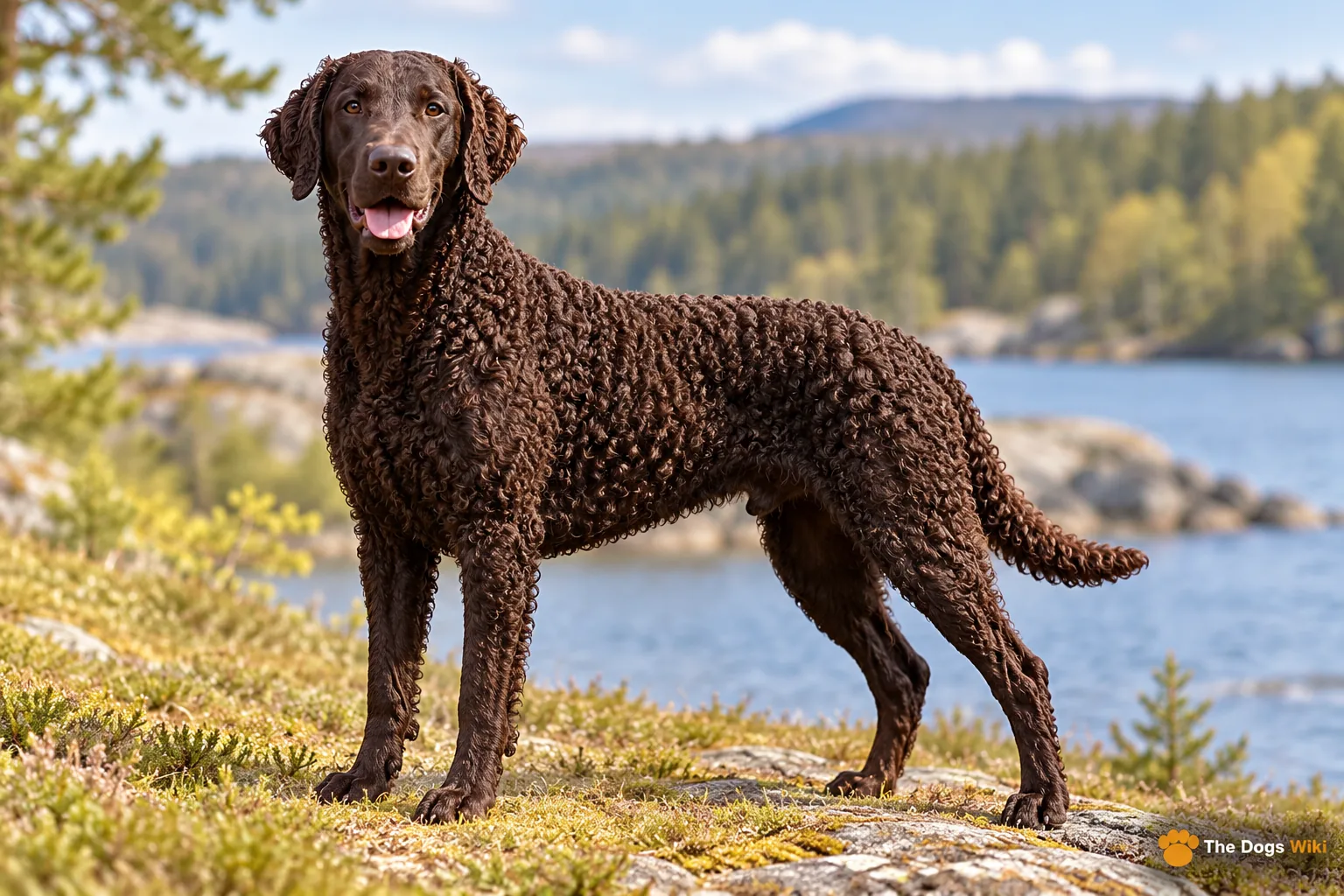
Curly-Coated Retrievers are a large, agile, muscular breed with a distinctive coat of small, tight, crisp curls covering the entire body, and a long, wedge-shaped head that sets the breed apart visually from other retrievers.
What Is the Average Curly-Coated Retriever Height and Weight?
| Measure | American Kennel Club figure |
|---|---|
| Height | 25-27 inches (male), 23-25 inches (female) |
| Weight | 60-95 pounds |
| Life expectancy | 10-12 years |
Figures are from the American Kennel Club Curly-Coated Retriever breed profile, retrieved September 2026.
How Long Do Curly-Coated Retrievers Live?
Curly-Coated Retrievers live 10 to 12 years. Regular veterinary care, including genetic screening for the breed-specific conditions covered below, supports a full lifespan.
What Health Problems Are Curly-Coated Retrievers Prone To?
Curly-Coated Retrievers are documented as being at higher risk for the following conditions.
- Exercise-induced collapse (EIC). An inherited neuromuscular disease causing sudden hind-limb weakness after exercise, with body temperature potentially reaching a life-threatening 107 degrees Fahrenheit during an episode; a DNA test can detect the genetic mutation.
- Glycogen storage disease type IIIa. An inherited disorder causing glycogen buildup in the liver, starting around 4 months of age and causing hypoglycemia and eventual liver failure if untreated.
- Cataracts and other eye conditions. The lens becomes cloudy, with the degree of vision impairment depending on the cataract’s size; surgery can restore eyesight in some cases.
- Bloat, or gastric dilatation-volvulus (GDV). A life-threatening emergency in deep-chested breeds; some veterinarians recommend a preventive gastropexy procedure.
- Cancer, including lymphoma, and hip dysplasia. Both recognized, breed-associated risks worth screening for with a veterinarian.
How Do You Groom a Curly-Coated Retriever?
Curly-Coated Retrievers have a distinctive coat of tight curls that’s genuinely low-maintenance in one specific sense, rarely needing brushing since brushing can damage the curl pattern, but the coat is naturally oily, which can make the breed a poor choice for allergy-sensitive households. Occasional bathing and routine nail trims, ear checks, and dental care round out the grooming routine.
How Much Exercise Does a Curly-Coated Retriever Need?
A Curly-Coated Retriever needs 60 to 90 minutes of exercise daily, including walks, playtime, and genuine mental stimulation, and the breed does well with activities like swimming and retrieving that tap directly into its working heritage. A large, securely fenced yard matters given the breed’s genuine athleticism, and the breed’s large size means it could accidentally knock over smaller children during enthusiastic play.
Are Curly-Coated Retrievers Easy to Train?
Curly-Coated Retrievers are generally considered intelligent and easy to train, though the breed can be stubborn and is genuinely slow to mature, which means training may take longer to fully click compared to other retriever breeds. Firm but not aggressive, non-repetitive training with real variety works best for this independent-minded breed.
What Should You Feed a Curly-Coated Retriever?
Curly-Coated Retrievers do well on a balanced formula suited to their age and genuinely high activity level, and because the breed carries a documented risk of glycogen storage disease affecting blood sugar regulation, consistent, measured feeding matters. A veterinarian can help set an appropriate feeding plan.
What Are the Pros and Cons of Owning a Curly-Coated Retriever?
Here are the main advantages of owning a Curly-Coated Retriever.
- Confident, even-tempered, genuinely loyal temperament
- Distinctive, low-brushing curly coat
- More naturally watchful than most other retriever breeds
- Determined, durable worker in the field or water
Here are the main drawbacks of owning a Curly-Coated Retriever.
- Documented risk of exercise-induced collapse and glycogen storage disease
- Genuinely slow to mature, which can extend the training timeline
- Oily coat can be a poor fit for allergy-sensitive households
- More reserved with strangers and less good with other dogs than most retrievers
Curly-Coated Retriever rescue organizations place adult dogs, though the breed’s relative rarity can limit availability, worth a look for anyone drawn to the breed’s distinctive look and loyal temperament but not set on a breeder search.
What Else Do People Ask About the Curly-Coated Retriever?
The questions below cover how much a Curly-Coated Retriever costs, whether Curly-Coated Retrievers are good family dogs, why the Curly-Coated Retriever’s coat is so unique, and what exercise-induced collapse is in Curly-Coated Retrievers.
How much does a Curly-Coated Retriever cost?
Curly-Coated Retriever prices vary by region, bloodline, and breeder reputation, and a puppy from a breeder affiliated with the Curly-Coated Retriever Club of America who screens for eye, heart, and hip health typically costs more than one that doesn’t. Adopting an adult Curly through a rescue is usually a lower-cost alternative, though the breed’s rarity can limit availability.
Are Curly-Coated Retrievers good family dogs?
Curly-Coated Retrievers can be good family dogs, in particular for households with older children, given the breed’s large size and potential to accidentally knock over a small child during enthusiastic play. The breed is genuinely good with kids overall but tends to be less immediately social with other dogs than most retrievers.
Why is the Curly-Coated Retriever’s coat so unique?
The Curly-Coated Retriever’s coat of small, tight, crisp curls is unlike any other retriever breed’s coat, developed specifically to protect the dog while working through thick bramble and swimming in icy water during hunts. Unlike most dog coats, brushing can damage the curl pattern, so the breed needs far less routine brushing than its long-coated cousins.
What is exercise-induced collapse in Curly-Coated Retrievers?
Exercise-induced collapse is an inherited neuromuscular disease causing sudden weakness in the hind legs after intense exercise, with a dog’s body temperature able to reach a life-threatening 107 degrees Fahrenheit during a severe episode. A DNA test can identify whether an individual dog carries the genetic mutation responsible, which is why screening breeding stock matters considerably for this breed.
Related Guides
More guides on The Dogs Wiki cover behavior, health, grooming, training, nutrition, and adoption.
| Guide |
|---|
| Behavior |
| Health |
| Grooming |
| Training |
| Nutrition |
| Adoption |