
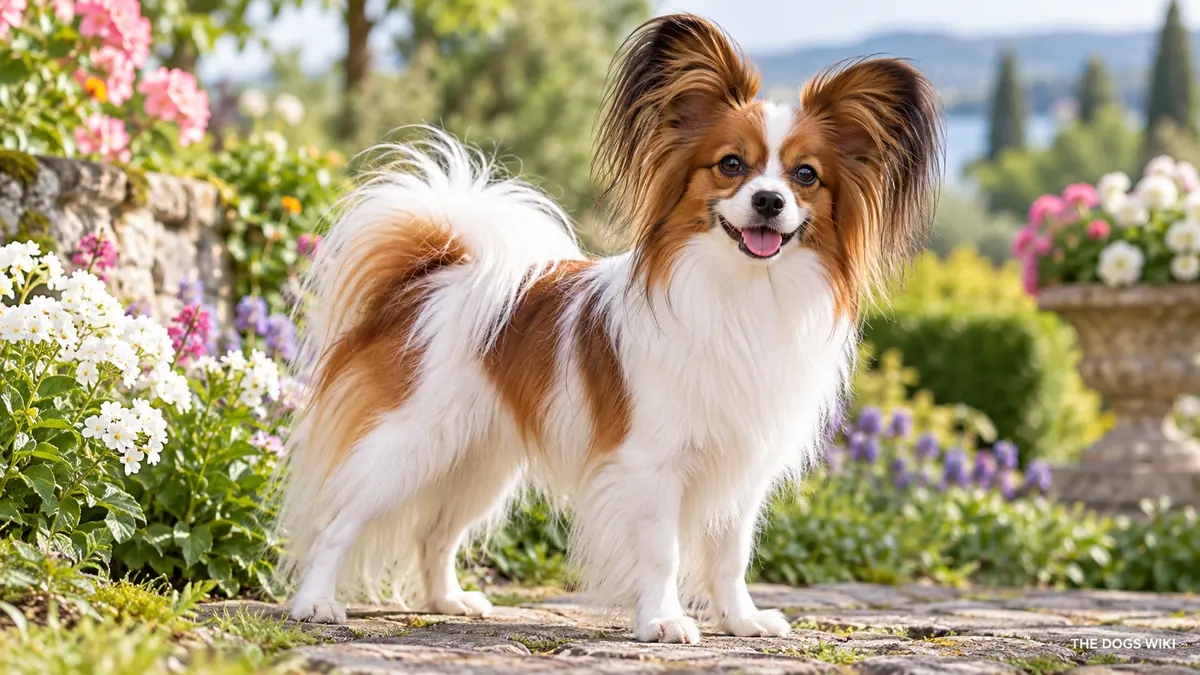
A Papillon is a small Toy Group breed named for the French word for butterfly, a reference to the breed’s distinctive fringed ears that flare out like wings.
Descended from the Continental Toy Spaniel and depicted in European royal court paintings dating back to the 16th century, the Papillon combines a delicate, elegant appearance with genuine athleticism and one of the sharpest minds in the entire Toy Group. This guide covers where the breed originated, its temperament, how big Papillons get, how long they live, the health problems they are prone to, grooming, how much exercise they need, how easy they are to train, what to feed them, the pros and cons of owning one, and what else people ask.
What Is a Papillon and Where Did the Breed Originate?
A Papillon belongs to the American Kennel Club’s Toy Group. Known historically as the “Dwarf Spaniel,” the breed was popular in the French royal court, under Louis XIV, and appears in numerous Renaissance-era paintings. Early Papillons had drooping ears, and it wasn’t until some point in the breed’s development that erect, butterfly-like ears emerged; both ear types remain correct under the breed standard, with drop-eared dogs called Phalene, French for “moth.” The AKC officially recognized the Papillon in 1915.
The American Kennel Club defines the breed in its “Official Standard of the Papillon”, approved June 10, 1991, which sets out the size, coat, and temperament a Papillon should have. As of September 2026, the AKC ranks the Papillon 44th of 210 breeds in popularity.
What Is a Papillon’s Temperament Like?
A Papillon’s temperament is happy, alert, and friendly, and the breed carries itself with an upbeat, athletic energy that belies its delicate, refined appearance. Papillons are intelligent and protective of their owner, getting along well with other dogs, cats, and children when socialized early, though some individuals can be timid or nervous without enough positive exposure to new situations. The breed doesn’t bark excessively and is neither shy nor aggressive by nature.
How Big Do Papillons Get?
Papillons are a small, dainty breed with a body slightly longer than tall, a fine bone structure, and a long, silky coat with no undercoat, meaning the breed doesn’t experience the biannual heavy shed common in double-coated dogs.
What Is the Average Papillon Height and Weight?
| Measure | American Kennel Club figure |
|---|---|
| Height | 8-11 inches |
| Weight | 5-10 pounds |
| Life expectancy | 14-16 years |
Figures are from the American Kennel Club Papillon breed profile, retrieved September 2026.
How Long Do Papillons Live?
Papillons live 14 to 16 years, among the longer lifespans of any dog breed, reflecting the breed’s overall sturdy constitution. Regular veterinary care supports a full lifespan for this healthy, long-lived breed.
What Health Problems Are Papillons Prone To?
Papillons are documented as being at higher risk for the following conditions.
- Patellar luxation. A common orthopedic issue in small breeds where the kneecap slips out of place, sometimes requiring surgery in severe cases.
- Progressive retinal atrophy. An inherited eye disease that gradually breaks down the retina, with no available cure once diagnosed.
- Open fontanelle. A soft spot in the skull that normally closes by 9 to 12 weeks of age but can persist into adulthood in some dogs, raising susceptibility to brain injury if it doesn’t close.
- Von Willebrand’s disease. An inherited bleeding disorder affecting the blood’s ability to clot properly.
- Dental problems. A common concern in small-mouthed toy breeds, managed with regular brushing and professional cleanings.
How Do You Groom a Papillon?
Papillons have a long, silky coat that, unlike many longhaired breeds, has no undercoat and genuinely doesn’t mat easily, making coat care more manageable than the breed’s dramatic appearance suggest. Daily brushing still helps keep the coat looking its best, and the breed is notable for having no doggy odor.
How Much Exercise Does a Papillon Need?
A Papillon needs at least 30 to 60 minutes of exercise a day, more than many toy breeds given the Papillon’s genuinely upbeat, athletic energy. The breed does well at agility and other dog sports, and its combination of intelligence and drive means physical exercise alone isn’t enough without real mental stimulation as well.
Are Papillons Easy to Train?
Yes, Papillons are considered among the most trainable breeds in existence, ranked 8th out of 138 breeds tested for working and obedience intelligence by canine researcher Stanley Coren. Positive reinforcement training suits the breed well, and given the Papillon’s intelligence, consistent mental engagement matters for preventing boredom-driven behavioral issues.
What Should You Feed a Papillon?
Papillons do well on a small-breed formula suited to their age and activity level, and given the breed’s genuine energy and drive, working with a veterinarian to set portions based on actual activity level, rather than the bag’s generic suggestion, is a reasonable approach.
What Are the Pros and Cons of Owning a Papillon?
Here are the main advantages of owning a Papillon.
- Happy, alert, genuinely friendly temperament
- Among the most trainable breeds of any size
- Long average lifespan
- Coat sheds minimally and doesn’t mat easily despite its length
Here are the main drawbacks of owning a Papillon.
- Needs more daily exercise than many toy breeds
- Some individuals can be timid without early, consistent socialization
- Prone to patellar luxation and von Willebrand’s disease
- Fragile enough that rough handling from young children needs supervision
Papillon rescue organizations place adult dogs, though the breed’s more modest popularity can limit availability, worth a look for anyone drawn to the breed’s bright personality but not set on a breeder search.
What Else Do People Ask About the Papillon?
The questions below cover how much a Papillon costs, whether Papillons are good family dogs, why the Papillon is considered one of the smartest dog breeds, and whether Papillons shed a lot.
How much does a Papillon cost?
Papillon prices vary by region, bloodline, and breeder reputation, and a puppy from a breeder who screens for eye and joint health typically costs more than one that doesn’t. Adopting an adult Papillon through a rescue is usually a lower-cost alternative, though the breed’s relative rarity can limit availability.
Are Papillons good family dogs?
Papillons can be good family dogs, in particular with older children who understand how to handle a small, delicate breed gently, and with early socialization the breed generally does well with other pets too. Younger children should be supervised, since Papillons are lively enough to get underfoot but small enough to be genuinely injured by rough handling.
Why is the Papillon considered one of the smartest dog breeds?
The Papillon consistently ranks among the top 10 smartest dog breeds in canine intelligence research, placing 8th out of 138 breeds tested by researcher Stanley Coren for working and obedience intelligence. This intelligence shows up in the breed’s quick learning, success in agility and obedience competition, and genuine need for mental stimulation to stay well-behaved.
Do Papillons shed a lot?
No, Papillons shed relatively little for a longhaired breed, since they lack an undercoat and don’t go through the heavy biannual “blowout” common in double-coated dogs. The coat also resists matting better than many long coats, which makes day-to-day care more manageable than the breed’s elegant appearance might suggest.
Related Guides
More guides on The Dogs Wiki cover behavior, health, grooming, training, nutrition, and adoption.
| Guide |
|---|
| Behavior |
| Health |
| Grooming |
| Training |
| Nutrition |
| Adoption |
Comments
One response to “Papillon: Breed Profile, Temperament, Health, and Care Guide”
[…] Papillon […]