
Home → Dog Breeds → Herding Group → Australian Cattle Dog
Australian Cattle Dog: Breed Profile, Temperament, Health, and Care Guide
An Australian Cattle Dog, also called a Blue Heeler or Red Heeler, is a medium-sized Herding Group breed developed in Australia around 1840 from Dingoes and Collies to herd cattle across the Outback.
An Australian Cattle Dog, commonly called a Blue Heeler or Red Heeler depending on coat color, is a medium-sized Herding Group breed developed around 1840 by crossing the native Australian Dingo with imported Scottish Collies, later refined with Dalmatian and Kelpie bloodlines to herd cattle across the brutal terrain and long distances of the Australian Outback. That demanding heritage produced among the most hardworking, independent-minded breeds in existence, exemplified by Bluey, a Cattle Dog who holds the Guinness World Record as the oldest dog ever recorded at 29 years old. This guide covers where the breed originated, its temperament, how big Australian Cattle Dogs get, how long they live, the health problems they are prone to, grooming, how much exercise they need, how easy they are to train, what to feed them, the pros and cons of owning one, and what else people ask.
What Is an Australian Cattle Dog and Where Did the Breed Originate?
An Australian Cattle Dog belongs to the American Kennel Club’s Herding Group. The breed originated around 1840 from a cross between the native Dingo and an imported Scottish smooth-coated Collie, producing a dog well suited to Australia’s high temperatures and rough outback terrain. Breeders later added the Dalmatian for ease with horses and faithfulness, and the Black and Tan Kelpie for work drive, resulting in the breed’s current mix of traits. Robert Kaleski wrote the first formal breed standard in 1897, and the AKC recognized the Australian Cattle Dog in 1980, initially under the Working Group before it moved to the Herding Group.
The American Kennel Club defines the breed in its “Official Standard of the Australian Cattle Dog”, approved January 11, 1999, which sets out the size, coat, and temperament an Australian Cattle Dog should have. As of September 2026, the AKC ranks the Australian Cattle Dog 52nd of 210 breeds in popularity.
What Is an Australian Cattle Dog’s Temperament Like?
An Australian Cattle Dog’s temperament is intelligent, independent, and genuinely tireless, described by many owners as having a “go, go, go” personality that rarely slows down. The breed is playful, loyal, and affectionate at home but shows a stern, cautious reserve toward strangers, a trait that makes it an excellent watchdog. Cattle Dogs bond intensely to one particular person and can genuinely object to being separated from them, and without proper socialization, the breed’s herding instinct can show up as nipping at the heels of children or other pets.
How Big Do Australian Cattle Dogs Get?
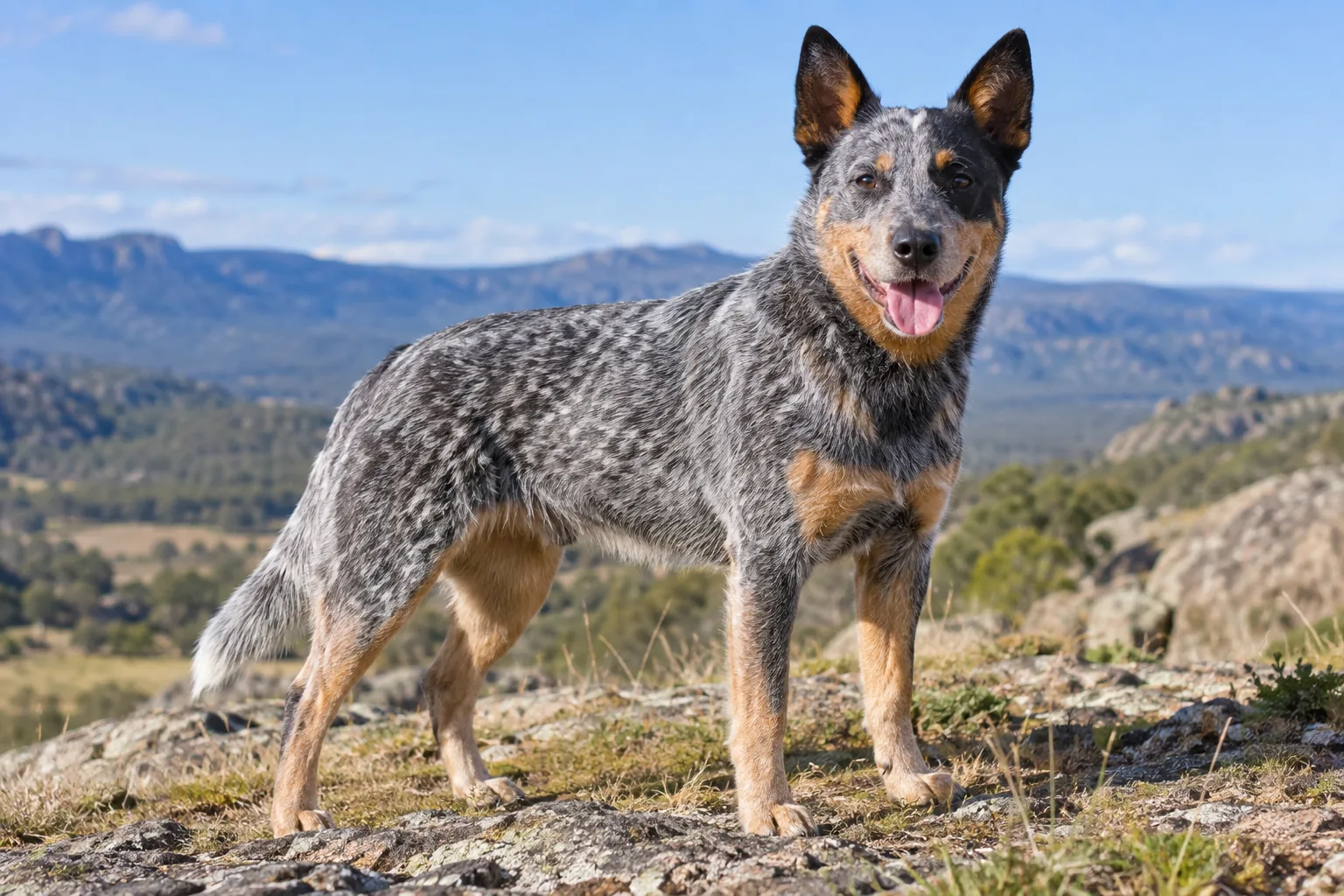
Australian Cattle Dogs are a compact, stocky, muscular breed built for strength, endurance, and stamina, with a short double coat in blue-speckled or red-speckled patterns that give the breed its “Blue Heeler” and “Red Heeler” nicknames.
What Is the Average Australian Cattle Dog Height and Weight?
| Measure | American Kennel Club figure |
|---|---|
| Height | 18-20 inches (male), 17-19 inches (female) |
| Weight | 35-50 pounds |
| Life expectancy | 12-16 years |
Figures are from the American Kennel Club Australian Cattle Dog breed profile, retrieved September 2026.
How Long Do Australian Cattle Dogs Live?
Australian Cattle Dogs live 12 to 16 years, and the breed holds a genuinely remarkable record: an Australian Cattle Dog named Bluey lived to 29 years old, the oldest dog ever documented according to the Guinness Book of World Records. Regular veterinary care and consistent exercise support a full, healthy lifespan for this hardy breed.
What Health Problems Are Australian Cattle Dogs Prone To?
Australian Cattle Dogs are documented as being at higher risk for the following conditions.
- Sensorineural deafness. A hereditary hearing loss condition, more common in the breed given its association with piebald and merle coat genetics.
- Hip and elbow dysplasia. Joint conditions common in active, medium-sized breeds, screened for with x-rays in reputable breeding programs.
- Progressive retinal atrophy. An inherited eye disease that gradually breaks down the retina and can lead to vision loss.
- Heart conditions. Recognized, breed-associated cardiac concerns worth discussing with a veterinarian as part of routine care.
- Cranial cruciate ligament injuries. Knee injuries that can result from the breed’s high-intensity activity level, sometimes requiring surgical repair.
How Do You Groom an Australian Cattle Dog?
Australian Cattle Dogs have a short, dense, weather-resistant double coat that’s genuinely low-maintenance, needing only regular brushing to remove loose hair and debris. Routine ear cleaning, nail trims, and dental care round out the grooming routine for this practical, easy-care coat.
How Much Exercise Does an Australian Cattle Dog Need?
An Australian Cattle Dog needs a genuinely high degree of exercise, and the breed does best with extended sessions of running, jogging, frisbee, or agility training rather than a short walk. This isn’t a breed suited to apartment living or a small yard, and a Cattle Dog that’s under-exercised is prone to restlessness and destructive behavior, since the breed’s work drive doesn’t fade in a companion role.
Are Australian Cattle Dogs Easy to Train?
Australian Cattle Dogs are highly intelligent, sometimes described as intelligent enough to routinely outsmart their owners, but the breed’s genuine independence means training takes real consistency. Firm, positive, varied training works best, and given the breed’s history working independently across large ranches, a Cattle Dog needs a handler who can match its confidence and drive.
What Should You Feed an Australian Cattle Dog?
Australian Cattle Dogs eat around 2 to 2.5 cups of high-quality food daily, split into two meals, and given the breed’s genuinely high activity level, a formula rich in protein, vegetables, and healthy fats suits the breed’s needs better than one padded with grain-based fillers.
What Are the Pros and Cons of Owning an Australian Cattle Dog?
Here are the main advantages of owning an Australian Cattle Dog.
- Intelligent, loyal, genuinely tireless work ethic
- Excellent watchdog given natural wariness toward strangers
- Low-maintenance short coat
- Well suited to active owners, those with ranch, farm, or serious outdoor lifestyles
Here are the main drawbacks of owning an Australian Cattle Dog.
- Needs 1 to 2 hours of vigorous daily exercise, not suited to apartment living
- Strong single-person attachment can complicate multi-person households
- Herding instinct can lead to nipping at children or other pets
- Independent streak requires an experienced, confident handler
Australian Cattle Dog rescue organizations place adult dogs regularly, worth a look for anyone drawn to the breed’s work ethic but not set on a breeder search.
What Else Do People Ask About the Australian Cattle Dog?
The questions below cover how much an Australian Cattle Dog costs, whether Australian Cattle Dogs are good family dogs, why the Australian Cattle Dog is called a Blue Heeler, and whether the oldest dog ever recorded was an Australian Cattle Dog.
How much does an Australian Cattle Dog cost?
Australian Cattle Dog puppies from a reputable breeder cost between $800 and $1,500, though prices vary by region and bloodline, while adoption fees through a rescue range from $150 to $400. Adopting through a rescue is usually the lower-cost path.
Are Australian Cattle Dogs good family dogs?
Australian Cattle Dogs can be good family dogs for genuinely active households, though the breed’s intense energy, independent streak, and herding instinct mean it isn’t a good match for a sedentary family or one unprepared to manage nipping behavior around young children.
Why is the Australian Cattle Dog called a Blue Heeler?
The nickname “Blue Heeler” comes from the breed’s blue-speckled coat pattern combined with its herding technique of nipping at the heels of cattle to move them, a behavior directly bred into the dog for working large livestock across the Australian Outback. Red-coated individuals are correspondingly nicknamed “Red Heelers.”
Was the oldest dog ever recorded an Australian Cattle Dog?
According to the Guinness Book of World Records, the oldest dog ever documented was an Australian Cattle Dog named Bluey, who lived to be 29 years old, roughly double the breed’s already solid average lifespan. While an extreme outlier, Bluey’s longevity reflects the breed’s overall reputation for hardiness.
Related Guides
More guides on The Dogs Wiki cover behavior, health, grooming, training, nutrition, and adoption.
| Guide |
|---|
| Behavior |
| Health |
| Grooming |
| Training |
| Nutrition |
| Adoption |
Leave a Reply