
Home → Dog Breeds → Non-Sporting Group → French Bulldog
A French Bulldog is a small, compact Non-Sporting Group breed that began in England as a miniature Bulldog and was shaped in France, and it has been the AKC’s most registered breed since 2022.
A French Bulldog is a small, compact Non-Sporting Group breed developed in England as a miniature version of the Bulldog before French lace workers who emigrated to France in the 1800s brought the dog with them and helped shape it into the breed known today. Despite the name, the French Bulldog’s roots are as much English as French, and its modern popularity has made it the American Kennel Club’s most registered breed since 2022. This guide covers where the breed originated, its temperament, how big French Bulldogs get, how long they live, the health problems they are prone to, grooming, how much exercise they need, how easy they are to train, what to feed them, the pros and cons of owning one, and what else people ask.
What Is a French Bulldog and Where Did the Breed Originate?
A French Bulldog belongs to the American Kennel Club’s Non-Sporting Group, a catch-all category for breeds that don’t fit neatly into the other six. The breed began in England as a smaller version of the Bulldog, bred down in size to work as a companion for lace makers in Nottingham. When the lace industry declined and many workers relocated to France in the mid-1800s, they brought their small Bulldogs with them, and French breeders further developed the distinctive upright “bat ears” that now define the breed’s look. Popularity has surged over the past decade, and the breed became the AKC’s number one most registered breed in 2022, a position it has held since.
The American Kennel Club defines the breed in its “Official Standard of the French Bulldog”, approved April 10, 2018, which sets out the size, coat, and temperament a French Bulldog should have. As of September 2026, the AKC ranks the French Bulldog 1st of 210 breeds in popularity.
Which French Bulldog Colors Does the Breed Standard Accept?
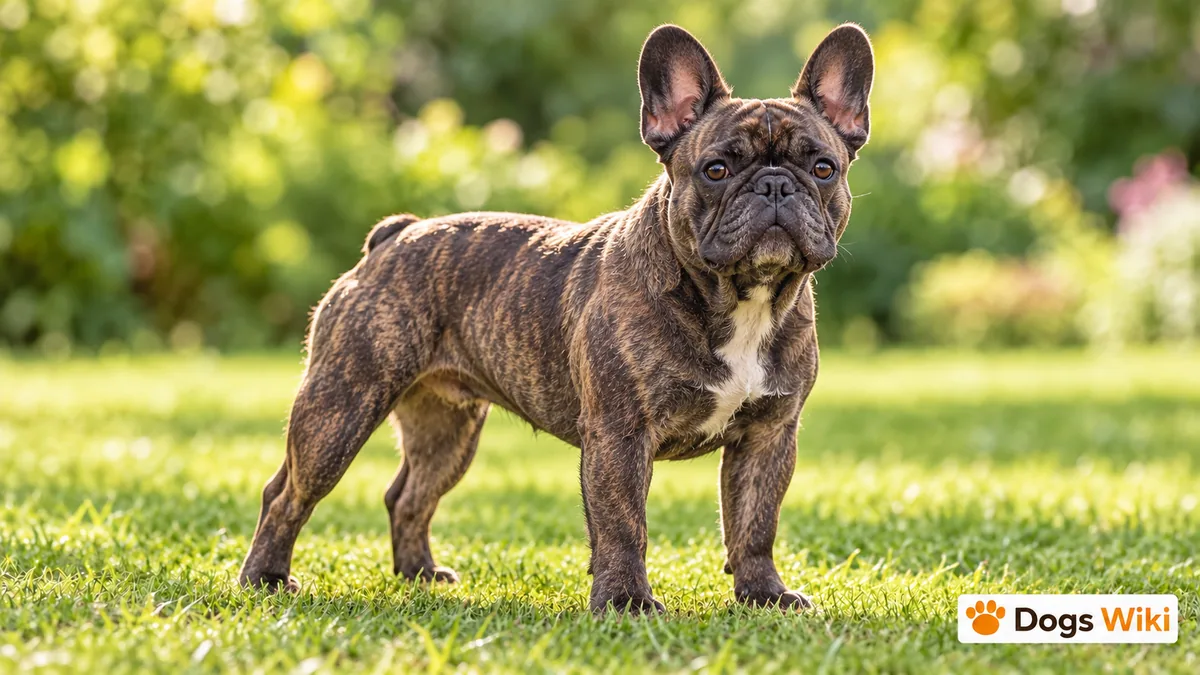
The standard accepts white, cream, and fawn, from light fawn to red fawn, in any combination, with brindle, piebald, black masks, black shadings, and white markings as allowed patterns. Blue, blue fawn, liver, merle, solid black, and black and tan all count as disqualifications in the show ring. Sellers who advertise “rare” colors at a premium are selling exactly the coats the standard rules out, and some of those colors come with their own health baggage, since merle genetics are tied to deafness and eye defects in several breeds.
What Is a French Bulldog’s Temperament Like?
A French Bulldog’s temperament is easygoing, playful, and affectionate, with low energy and minimal barking that suits apartment living well. The standard itself describes the ideal dog as “well behaved, adaptable, and comfortable,” active and alert without being boisterous. That said, the breed can be prone to separation anxiety, since these dogs bond closely with their people and don’t always do well being left alone for long stretches. In a household, this translates into a dog that’s happy to be a lap companion, gets along well with familiar people and pets, and doesn’t demand the kind of intense daily exercise many other breeds need.
How Does a French Bulldog Get Along With Children and Other Pets?
Most French Bulldogs are patient, sturdy companions for children who know how to handle a dog gently. Their low center of gravity makes them less fragile than toy breeds of a similar weight. Supervision still matters, because a child who squeezes the chest or lifts the dog awkwardly can strain an airway and a spine that are already under pressure. With other pets, a well-socialized Frenchie mixes easily, although some males spar with dogs of the same sex. Early, calm introductions work better than throwing a new puppy into a busy dog park.
How Big Do French Bulldogs Get?
French Bulldogs are a compact, muscular breed with a broad chest and heavy bone relative to their small overall size. The breed’s signature upright “bat ears” and flat face are both part of the official breed standard and are also directly connected to the health considerations covered below. Weight over 28 pounds is a disqualification under the standard, so a lean adult sits comfortably under that line.
What Is the Average French Bulldog Height and Weight?
| Measure | American Kennel Club figure |
|---|---|
| Height | 11-13 inches |
| Weight | under 28 pounds |
| Life expectancy | 10-12 years |
Figures are from the American Kennel Club French Bulldog breed profile, retrieved September 2026.
How Long Do French Bulldogs Live?
French Bulldogs live 10 to 12 years. As with other brachycephalic, or flat-faced, breeds, the main factor limiting lifespan is the breed’s airway structure, which can affect breathing and overall health over time. Careful management of the breed’s specific health risks, covered below, along with regular veterinary care, helps support a French Bulldog toward a full, comfortable lifespan. Keeping the dog lean costs nothing. Every extra pound adds load to the chest and the spine.
What Health Problems Are French Bulldogs Prone To?
French Bulldogs are documented as being at higher risk for the following conditions, most connected to the breed’s flat-faced, compact build.
What Is Brachycephalic Obstructive Airway Syndrome (BOAS) in French Bulldogs?
Brachycephalic obstructive airway syndrome is a set of airway defects caused by a shortened skull: narrow nostrils, an elongated soft palate, a narrow windpipe, and swollen tissue at the entrance to the larynx. Signs include loud breathing at rest, snoring, gagging, poor exercise tolerance, and collapse in heat. Surgery to widen the nostrils and shorten the soft palate improves breathing in many dogs. In the UK, the University of Cambridge and the Kennel Club run a Respiratory Function Grading Scheme that scores dogs from grade 0 to grade III after an exercise test.
What Is Hemivertebrae in French Bulldogs?
Hemivertebrae are malformed, wedge-shaped bones in the spine that form before birth. The same malformation produces the short, screwed tail seen in many French Bulldogs. Plenty of affected dogs never show a problem, yet in others the spine angles sharply enough to press on the spinal cord, causing hind-leg weakness, wobbling, or incontinence. X-rays, CT, or MRI confirm the diagnosis, and surgery is reserved for dogs with nerve signs.
What Is Skin Fold Dermatitis in French Bulldogs?
Skin fold dermatitis is an infection of the skin inside a fold, where trapped moisture and warmth let bacteria and yeast multiply. On a Frenchie, the facial wrinkle over the nose and the pocket around a tight tail are the usual trouble spots. Redness, a sour smell, and brown discharge are the warning signs. Wiping and fully drying the folds several times a week prevents most cases.
What Is Heat Intolerance in French Bulldogs?
Heat intolerance is the breed’s reduced ability to cool itself. Dogs shed heat mainly by panting, and a short, narrow airway moves far less air. Heatstroke can set in on a warm day during a walk that a longer-nosed dog would shrug off. Heavy, noisy panting, bright red gums, drooling, and stumbling mean the dog needs shade, cool water on the body, and a vet at once. The same front-heavy build means a French Bulldog sinks quickly in water.
What Is Intervertebral Disc Disease in French Bulldogs?
Intervertebral disc disease is the degeneration and rupture of the cushioning discs between the vertebrae. French Bulldogs carry the chondrodystrophic trait, so their discs harden early in life and are more prone to rupture. Back pain, a hunched stance, reluctance to jump or climb stairs, and dragging hind legs all point to a disc problem. Sudden weakness or paralysis is an emergency, and treatment ranges from strict crate rest to spinal surgery.
Which Health Screenings Should a French Bulldog Breeder Provide?
Ask to see results for both parents rather than a verbal promise. Useful records include Orthopedic Foundation for Animals results for hips, patellas, heart, and eyes, an airway assessment or respiratory grade, and DNA results for the inherited conditions the breed club tracks. Buyers should also ask how the litter was delivered. Most French Bulldog puppies arrive by caesarean section, and a 2010 study titled “Proportion of litters of purebred dogs born by caesarean section” put the breed’s rate at 81 percent, one reason puppies cost so much.
How Do You Groom a French Bulldog?
French Bulldogs have a short, smooth coat that sheds lightly, so brushing needs are minimal, once a week is enough to manage loose hair. The bigger grooming priority is the facial wrinkles, which need regular wiping and thorough drying to prevent moisture and bacteria from causing skin fold dermatitis. Routine nail trims and ear checks round out the routine. Bath water should stay comfortably cool, because the breed is prone to overheating.
| Grooming task | How often |
|---|---|
| Brush the coat with a rubber mitt or soft brush | Once a week |
| Wipe and dry facial and tail folds | Several times a week |
| Check and clean the ears | Weekly |
| Trim nails | Every 3 to 4 weeks |
| Brush teeth | Daily, or at least three times a week |
| Bath | Every 1 to 2 months, or when dirty |
How Much Exercise Does a French Bulldog Need?
A French Bulldog needs low exercise, generally short daily walks are enough, and activity should be limited during hot or humid weather given the breed’s airway structure. This is a low-energy breed by design, well suited to apartment living, but that doesn’t mean no exercise at all, since some daily activity still supports healthy weight and joint function. Watching closely for signs of overheating or labored breathing during any activity, and stopping immediately if they appear, matters more with this breed than with most others.
How Should French Bulldog Exercise Change With the Weather and Age?
Two or three walks of 15 to 20 minutes suit most healthy adults. In summer, walk at dawn and after dark, and skip the walk entirely on hot, humid days in favor of indoor games. A harness takes pressure off the throat, which a collar pulls against. Puppies do best with short play sessions and no forced running or jumping from furniture while the spine is still developing. Seniors keep their muscle and their weight in check with gentle, frequent strolls rather than one long outing.
Are French Bulldogs Easy to Train?
French Bulldogs are intelligent but can be independent-minded, which means training sometimes takes more patience than with more naturally eager-to-please breeds. Short, positive-reinforcement sessions work best, both because they suit the breed’s attention span and because the breed’s low physical stamina makes long training sessions counterproductive. Consistency matters more than intensity with this breed.
What Should French Bulldog Training Focus On First?
House-training comes first, and it is the area where owners report the most frustration. A regular schedule, a crate sized to the dog, and praise the moment the puppy finishes outside shorten the process. Next on the list is being left alone: short absences that build up gradually teach a puppy that its person comes back, which heads off separation anxiety later. Food rewards work well, though every treat counts toward the daily ration for a breed that gains weight easily.
What Should You Feed a French Bulldog?
Standard feeding guidance applies to French Bulldogs, but owners should watch weight closely, since excess weight makes the breed’s existing breathing difficulties measurably worse. A formula suited to the dog’s age and activity level, fed in measured portions, is the right starting point, and keeping a French Bulldog lean rather than merely “not overweight” is important given how directly extra weight compounds this breed’s airway issues.
How Many Meals a Day Does a French Bulldog Need?
Puppies eat three or four small meals a day until about six months of age, then move to two meals. Adults stay on two measured meals, which is easier on a dog that gulps air and food at the same time. Kibble shaped for flat-faced breeds, or a slow-feeder bowl, cuts down on gulping and regurgitation. You should be able to feel the ribs under a thin layer of fat; a dog whose waist has disappeared needs a smaller portion.
What Are the Pros and Cons of Owning a French Bulldog?
Here are the main advantages and drawbacks of owning a French Bulldog, side by side.
| Pros | Cons |
|---|---|
| Easygoing, affectionate temperament well suited to apartment living | Prone to breathing difficulties and heat intolerance |
| Low exercise needs compared to most breeds | Cannot swim safely and should never be left unsupervised near water |
| Minimal barking, a genuine advantage in shared living spaces | Among the most expensive popular breeds to buy and insure |
| Low-shedding, low-maintenance coat | Can develop separation anxiety if left alone frequently for long periods |
Buyers who like the breed’s temperament and low exercise needs but balk at the purchase price can look at French Bulldog rescue organizations, which do place adult dogs, though given the breed’s current popularity, availability and cost through rescue can vary more than with less in-demand breeds. People who want a larger dog with a similar temperament should read the Bulldog profile before deciding.
What Else Do People Ask About the French Bulldog?
The questions below cover the price of a French Bulldog, whether an apartment is a good home for one, why swimming is unsafe for the breed, the difference between the French Bulldog and the Bulldog, and how common health problems are in the breed.
What is the price of a French Bulldog?
French Bulldogs are among the most expensive popular breeds to buy, largely driven by high demand relative to the number of puppies bred, and the breed’s health needs also tend to make insurance and veterinary costs higher than average over a dog’s lifetime. Prices vary considerably by region, coat color, and breeder reputation, and adopting an adult French Bulldog through a rescue is a lower-cost alternative, though demand for the breed means rescue availability can be limited.
Is an apartment a good home for a French Bulldog?
Yes, French Bulldogs are well suited to apartment living, thanks to low exercise needs and minimal barking compared to most breeds. Their small size and easygoing temperament also make them a manageable fit for smaller living spaces, though owners should still plan for short daily walks and be mindful of noise from neighbors given the breed’s tendency toward separation anxiety when left alone. Air conditioning in summer is a necessity rather than a luxury for this breed.
Why is swimming unsafe for a French Bulldog?
French Bulldogs struggle to swim because of their front-heavy, compact build combined with a short airway that makes it hard to keep their head above water while breathing effectively. Unlike breeds developed for water work, French Bulldogs can tire or begin to struggle quickly, which is why the breed should never be left unsupervised near a pool, lake, or any body of water, even shallow ones. A properly fitted dog life jacket is the minimum for any boat trip or pool day.
What Is the Difference Between the French Bulldog and the Bulldog?
French Bulldogs and Bulldogs are both brachycephalic Non-Sporting Group breeds with calm, affectionate temperaments, but they differ considerably in size and cost. A Frenchie weighs under 28 pounds compared to the Bulldog’s 40 to 50 pound frame, and it has distinctive upright “bat ears” versus the Bulldog’s smaller, rose-shaped ears. Purchase prices for the French Bulldog run higher as well, reflecting their position as the AKC’s most popular breed.
How common are health problems in the French Bulldog?
Health problems are common in French Bulldogs, and they are documented as having a higher rate of health issues than many breeds, primarily tied to their brachycephalic, or flat-faced, structure, which affects breathing, heat tolerance, and in some cases spinal health. Choosing a breeder who screens for airway and spinal issues, and staying attentive to weight management and heat exposure, meaningfully reduces the impact of these risks over a dog’s lifetime, though they don’t disappear entirely.
Related Guides
More guides on The Dogs Wiki cover behavior, grooming, training, nutrition, and adoption.
| Guide |
|---|
| Behavior |
| Grooming |
| Training |
| Nutrition |
| Adoption |



Comments
6 responses to “French Bulldog: Breed Profile, Temperament, Health, and Care Guide”
[…] French Bulldog […]
[…] French Bulldog […]
[…] French Bulldog. Currently the AKC’s most popular breed, with prices driven up by unusually high demand relative to available puppies; see our dedicated Cost of a French Bulldog guide. […]
[…] who wants slightly fewer breathing-related health risks and a bit more natural energy. See the full French Bulldog guide and Boston Terrier guide for complete breed […]
[…] French Bulldog […]
[…] French Bulldog […]