Home → Dog Breeds → Herding Group → Rough Collie
A Rough Collie is a medium to large Herding Group breed developed in Scotland to herd sheep, best known as the breed behind Lassie and one of the two AKC Collie coat varieties.
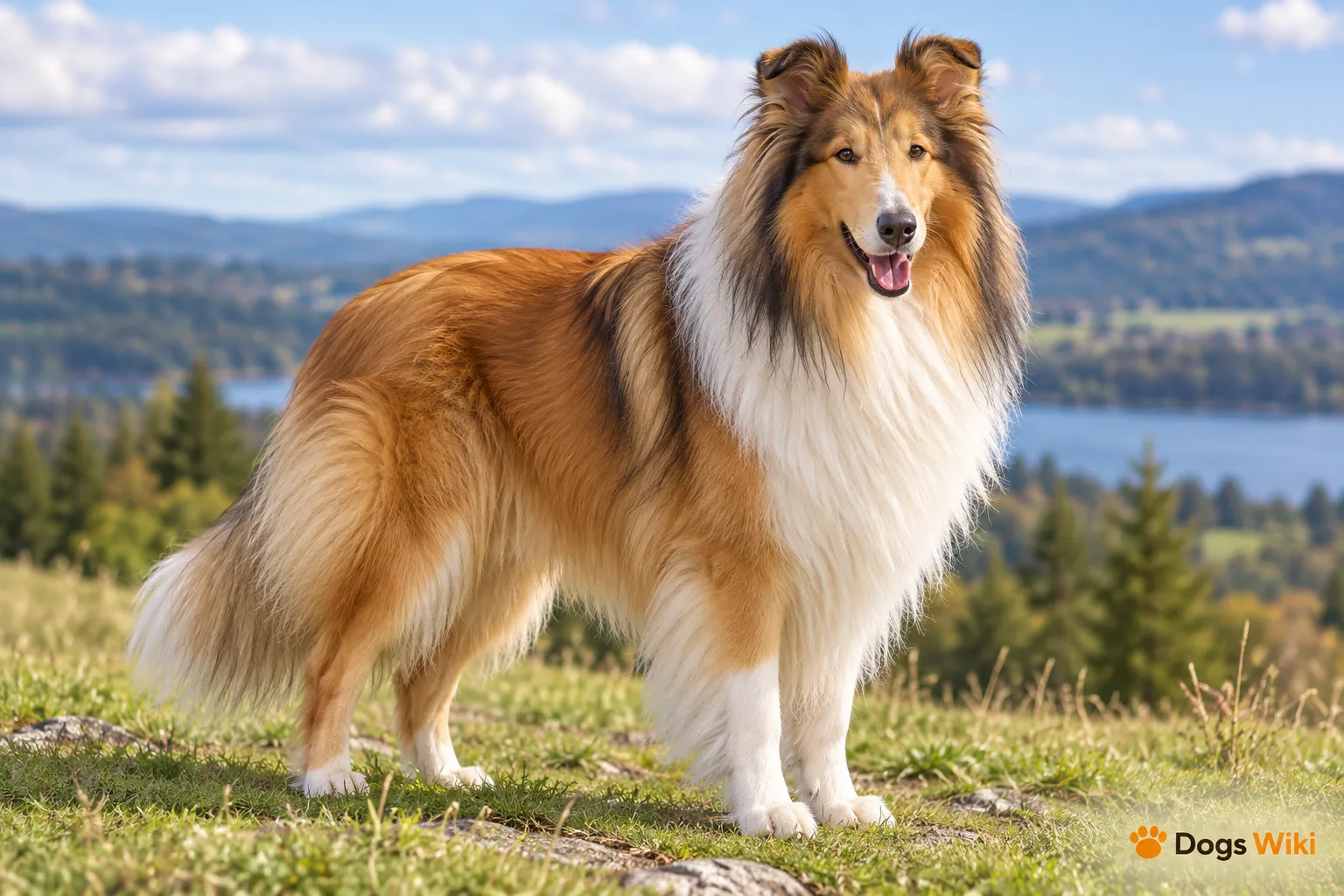
A Rough Collie is a medium to large Herding Group breed developed in Scotland to herd sheep across the countryside, best known today as the breed behind Lassie, the sable TV and film icon whose popularity drove a massive surge in the breed starting in the 1950s. Beyond the Hollywood association, the Rough Collie is a genuinely devoted, intelligent companion breed, one of the two AKC-recognized Collie coat varieties alongside the shorter-haired Smooth Collie. This guide covers where the breed originated, its temperament, how big Rough Collies get, how long they live, the health problems they are prone to, grooming, how much exercise they need, how easy they are to train, what to feed them, the pros and cons of owning one, and what else people ask.
What Is a Rough Collie and Where Did the Breed Originate?
A Rough Collie belongs to the American Kennel Club’s Herding Group and is one of two coat varieties of the AKC Collie breed, alongside the shorter-coated Smooth Collie. Traditionally, Rough Collies herded sheep, while their Smooth-coated cousins more often drove cattle, a distinction reflected in a somewhat stronger-willed temperament sometimes noted in Smooth Collies given their original purpose. The Collie Club of America became the second parent club to join the AKC in 1886. Popularity exploded worldwide from 1954 to 1973, driven almost entirely by the television series Lassie, whose title character was a sable Rough Collie.
The American Kennel Club defines the breed in its “Official Standard of the Collie”, approved May 10, 1977, which sets out the size, coat, and temperament a Rough Collie should have. As of September 2026, the AKC ranks the Rough Collie 39th of 210 breeds in popularity.
Which Collie Colors Does the Standard Allow?
Four colors are recognized with no preference among them: sable and white, tricolor, blue merle, and white. Sable ranges from pale gold to deep mahogany, while a white Collie is mostly white, preferably with sable, tricolor, or blue merle markings on the head. One judging rule applies to both varieties: the Smooth is held to the same standard as the Rough, except for the coat.
What Is a Rough Collie’s Temperament Like?
A Rough Collie’s temperament is strong, loyal, affectionate, and responsive, and the breed is widely regarded as among the most pleasing, easygoing family companions in the entire Herding Group. These are genuinely sensitive dogs, attuned to their family’s moods and eager to please, which means harsh training methods backfire with this breed far more than positive, consistent approaches. Most modern Rough Collies aren’t used for traditional herding but have found new purpose as assistance dogs and beloved family pets.
Do Rough Collies Bark a Lot?
Many do. The breed was developed to use their voice while working stock and to alert the farm to visitors, and a Collie left alone or bored can bark persistently. Teaching a “quiet” cue, rewarding calm, and giving the dog enough exercise and company keep the habit under control. Neighbors in close quarters notice a Collie that has not been taught when to stop.
How Big Do Rough Collies Get?
Rough Collies are a medium to large breed with an elegant, wedge-shaped head and a full, flowing double coat that streams beautifully when the dog runs, one of the breed’s most recognizable features.
What Is the Average Rough Collie Height and Weight?
| Measure | American Kennel Club figure |
|---|---|
| Height | 24-26 inches (male), 22-24 inches (female) |
| Weight | 60-75 pounds (male), 50-65 pounds (female) |
| Life expectancy | 12-14 years |
Figures are from the American Kennel Club Rough Collie breed profile, retrieved September 2026.
How Long Do Rough Collies Live?
Rough Collies live 12 to 14 years, with some sources citing a range from 10 to 16 years. Regular veterinary care, including awareness of the breed’s documented drug sensitivity covered below, supports a full lifespan.
What Health Problems Are Rough Collies Prone To?
Rough Collies are documented as being at higher risk for the following conditions.
What Is the MDR1 Gene Mutation in Rough Collies?
The MDR1 gene mutation is a drug sensitivity common in the breed, and studies have found that a large share of Collies carry at least one copy. Affected dogs cannot pump certain drugs out of the brain, so ivermectin at high doses, loperamide, and some sedatives and chemotherapy drugs can cause severe or fatal reactions. A cheek-swab test identifies carriers, and every vet treating the dog should know the result.
What Is Collie Eye Anomaly in Rough Collies?
Collie eye anomaly is a congenital eye disease that is common among Collies, affecting the retina, choroid, and sclera at the back of the eye. Many dogs have mild changes and see normally, while severe cases lead to retinal detachment and blindness. Puppies are best examined by a veterinary ophthalmologist at six to eight weeks of age, and a DNA test identifies carriers. Progressive retinal atrophy, a separate inherited eye condition, also occurs.
What Is Gray Collie Syndrome?
Gray Collie syndrome, or cyclic neutropenia, is an inherited disease in which the number of infection-fighting white blood cells crashes every one to two weeks. Affected puppies have a silvery-gray coat, grow poorly, and suffer repeated infections, and most die young. It is recessive, so a DNA test of both parents prevents affected litters.
What Other Health Problems Affect Rough Collies?
Dermatomyositis, an inflammatory skin and muscle disorder, causes crusting and hair loss on the face, ears, and legs of young dogs. Hip dysplasia occurs, and epilepsy is recognized in the breed. Bloat, a life-threatening gastric emergency in deep-chested breeds, requires immediate veterinary care when the belly swells and the dog retches without bringing anything up.
Which Health Tests Should a Rough Collie Breeder Provide?
Ask for an eye exam on the puppies and both parents, DNA results for MDR1, collie eye anomaly, progressive retinal atrophy, and gray collie syndrome, and OFA hip results. A breeder should also be willing to discuss dermatomyositis in the pedigree.
How Do You Groom a Rough Collie?
Rough Collies have a thick double coat with a long, harsh outer layer and a soft, cottony undercoat, and brushing two to three times a week prevents matting and manages shedding. Males shed the undercoat heavily about once a year, while females shed after each heat cycle and after raising a litter, so the heavy shedding periods come in bursts rather than year-round.
| Grooming task | How often |
|---|---|
| Line-brush with a pin brush and undercoat rake | Two to three times a week, daily during a shed |
| Comb behind the ears, under the legs, and the pants | Every brushing |
| Trim feet and hocks | Every 4 to 6 weeks |
| Trim nails | Every 3 to 4 weeks |
| Bath | Every 1 to 3 months |
Shaving is not recommended. The undercoat insulates against both heat and cold, and a shaved Collie coat can grow back unevenly.
How Much Exercise Does a Rough Collie Need?
A Rough Collie needs at least 45 to 60 minutes of outdoor activity daily, somewhat less than the more intensely driven Border Collie, but the breed is happy to settle down calmly once back inside. Walks, runs, and structured activities like agility or obedience suit the breed’s moderate-high energy level well.
Which Activities Suit a Rough Collie?
Herding, obedience, rally, agility, and tracking all suit the breed, and many Collies work as therapy dogs thanks to their gentle, attentive manner. Collies also learn household routines quickly and enjoy having small jobs, such as bringing in the newspaper or finding a named toy. Long walks and hikes in cool weather are favorites; the heavy coat makes summer midday exercise a poor idea. Puppies should avoid repeated jumping and long runs until their growth plates close at around a year.
Are Rough Collies Easy to Train?
Yes, Rough Collies are highly trainable, ranked among the most trainable breeds thanks to genuine intelligence paired with a strong desire to bond with their owner. Consistent, positive reinforcement training suits the breed’s sensitive nature well, and Rough Collies are known for responding intuitively to their family’s moods, which makes training sessions feel like a genuine collaboration rather than a chore.
What Should Rough Collie Training Focus On?
Barking control and handling top the list. Teach a “quiet” cue early, and get a puppy used to being brushed, having its feet touched, and standing on a grooming table, since a Collie will spend many hours being groomed over its life. Recall comes easily to most Collies, but practice it anyway around distractions. Keep the tone light; a Collie that feels pressured will shut down rather than try harder.
What Should You Feed a Rough Collie?
Most Collies do well on a balanced formula suited to their age and activity level, with portion sizes best determined alongside a veterinarian given the breed’s genuine size range. Senior Rough Collies benefit from adjusted portions and joint-supporting supplements as they age and slow down.
How Many Meals a Day Does a Rough Collie Need?
Puppies eat three meals a day until about six months, then two. Adults stay on two measured meals, which also lowers bloat risk compared with one large meal. The heavy coat hides weight gain, so run your hands along the ribs every few weeks; they should be easy to feel under a thin layer of fat.
What Are the Pros and Cons of Owning a Rough Collie?
Here are the main advantages and drawbacks of owning a Rough Collie, side by side.
| Pros | Cons |
|---|---|
| Strong, loyal, genuinely affectionate temperament | Documented MDR1 drug sensitivity requiring careful medication awareness |
| Highly trainable and intuitively attuned to family moods | Common risk of collie eye anomaly |
| Heavy shedding comes in bursts rather than continuously | High grooming commitment for the full, flowing coat |
| Calm indoors once daily exercise needs are met | Sensitive temperament that doesn’t tolerate harsh training |
Anyone drawn to the breed’s loyal temperament who would rather not search for a breeder can contact Rough Collie rescue organizations, which place adult dogs regularly.
What Else Do People Ask About the Rough Collie?
The questions below cover how much a Rough Collie costs, whether a family home is a good fit, whether Lassie was a Rough Collie, and what the MDR1 mutation in Rough Collies is.
How much does a Rough Collie cost?
Rough Collie prices vary by region, bloodline, and breeder reputation, and a puppy from a breeder who screens for eye health and MDR1 status costs more than one that doesn’t. Adopting an adult Rough Collie through a rescue is a lower-cost alternative.
Is a family home a good fit for a Rough Collie?
Yes, Rough Collies are widely regarded as excellent family dogs, known for a devoted, gentle temperament that’s attuned to the emotional needs of everyone in the household, including children. Their sensitivity means the whole family should use calm, positive interactions rather than harsh discipline.
Was Lassie a Rough Collie?
Yes. Lassie, the famous television and film character, was played by Rough Collies, starting with a male dog named Pal in the 1943 film “Lassie Come Home,” and his descendants played the role for decades afterward. The character’s massive popularity from the 1950s through the 1970s drove a well-documented surge in the breed’s real-world popularity during that period.
What is the MDR1 mutation in Rough Collies?
The MDR1 mutation is a genetic drug sensitivity common in Rough Collies and related herding breeds, which can cause severe or even fatal reactions to certain medications, including the antiparasitic drug ivermectin and the anti-diarrheal loperamide. A simple genetic test can determine whether an individual dog carries the mutation, information worth sharing with any veterinarian treating the dog.
Related Guides
More guides on The Dogs Wiki cover behavior, health, grooming, training, nutrition, and adoption.
| Guide |
|---|
| Behavior |
| Health |
| Grooming |
| Training |
| Nutrition |
| Adoption |