
Home → Dog Breeds → Working Group → Rottweiler
A Rottweiler is a large Working Group breed descended from drover dogs that accompanied Roman legions through the Alps, later settling in the German town of Rottweil, where they drove cattle to market and pulled carts loaded with butchered meat.
That working heritage earned the breed the nickname “Rottweiler Metzgerhund,” or Rottweil butcher’s dog, and it’s the root of the confident, protective temperament the breed still carries today. This guide covers where the breed originated, its temperament, how big Rottweilers get, how long they live, the health problems they are prone to, grooming, how much exercise they need, how easy they are to train, what to feed them, the pros and cons of owning one, and what else people ask.
What Is a Rottweiler and Where Did the Breed Originate?
A Rottweiler belongs to the American Kennel Club’s Working Group. The breed’s ancestry traces back over 2,000 years to Roman drover dogs, which later interbred with local dogs in Rottweil, Germany, and were used to herd livestock and pull carts of goods to market. Railroads replaced cattle droving in the late 1800s and a local law banned using dogs to pull carts, so the breed nearly vanished, but German fanciers revived it in the early 20th century for police and military work. American recognition followed in 1931, and the Rottweiler now consistently ranks among the AKC’s most popular breeds.
The American Kennel Club defines the breed in its “Official Standard of the Rottweiler”, approved May 10, 2022, which sets out the size, coat, and temperament a Rottweiler should have. As of September 2026, the AKC ranks the Rottweiler 8th of 210 breeds in popularity.
What Does the Rottweiler Breed Standard Rule Out?
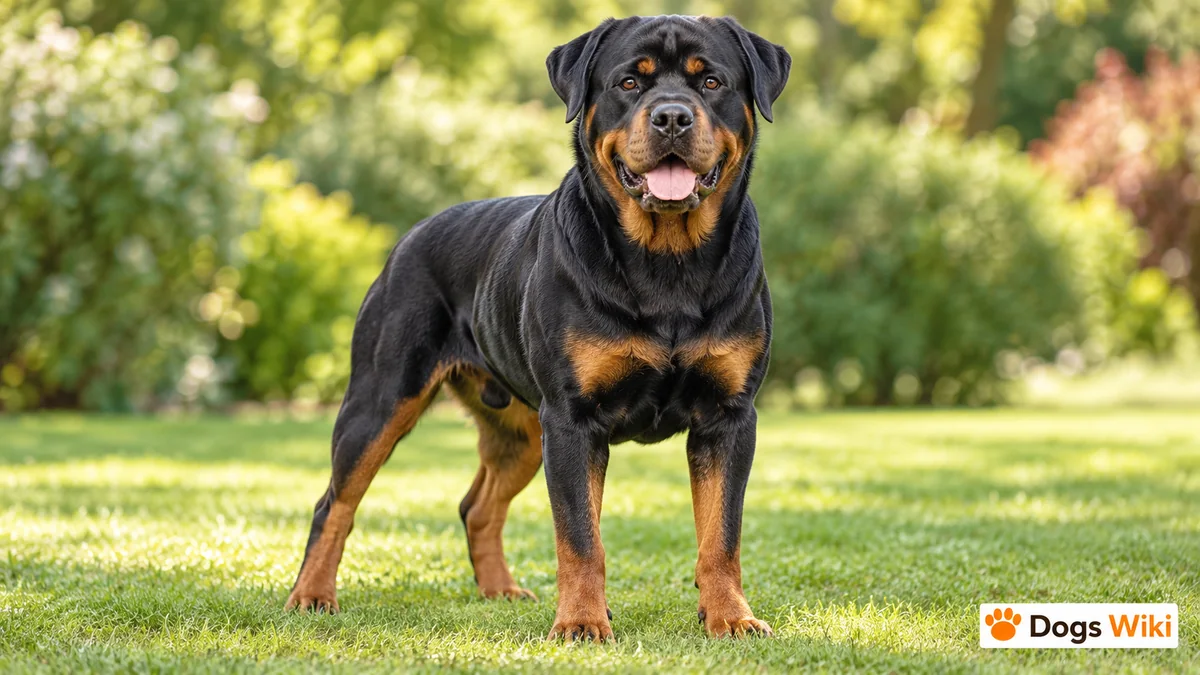
The standard is strict about a few points. Every Rottweiler must be black with clearly defined rust to mahogany markings, and any other base color, or the absence of markings, is a disqualification. A long coat is also disqualified, as are entropion and ectropion of the eyelids, two or more missing teeth, and a dog that attacks anyone in the ring. Puppies sold as “red,” “blue,” or “long-haired” Rottweilers fall outside the standard, whatever the price tag.
What Is a Rottweiler’s Temperament Like?
A Rottweiler’s temperament is calm, confident, and courageous, with a self-assured aloofness that doesn’t lend itself to instant friendliness with strangers. The standard describes a dog that “responds quietly and with a wait-and-see attitude” to its surroundings. According to the American Rottweiler Club, the breed’s temperament ranges from natural clowns who are affectionate with almost everyone to reserved, one-person dogs, and both extremes are considered within the normal range for the breed. Rottweilers have an inherent desire to protect home and family, which makes early, continuous socialization essential rather than optional for raising a well-adjusted adult.
How Does a Rottweiler Behave With Other Dogs?
Many Rottweilers live happily with a dog they grew up with. Same-sex aggression, however, is a recognized issue in the breed, and two adult males or two adult females in one home can clash. Meeting unfamiliar dogs on neutral ground, on leash, and with a calm handler prevents most trouble. Dog parks are a poor fit for many adult Rottweilers, because a scuffle with a dog this size draws blame whoever started it.
How Big Do Rottweilers Get?
Rottweilers are a medium-large, robust, and powerful breed with a compact, muscular build that denotes real strength and endurance. Males are noticeably more massive through the frame than females, who remain distinctly feminine without any weakness of structure.
What Is the Average Rottweiler Height and Weight?
| Measure | American Kennel Club figure |
|---|---|
| Height | 24-27 inches (male), 22-25 inches (female) |
| Weight | 95-135 pounds (male), 80-100 pounds (female) |
| Life expectancy | 9-10 years |
Figures are from the American Kennel Club Rottweiler breed profile, retrieved September 2026.
How Long Do Rottweilers Live?
Rottweilers live 9 to 10 years, on the shorter end for a breed of this size, and females outlive males on average. Research on exceptionally long-lived Rottweilers found that females who kept their ovaries longer were more likely to reach 13 years or older. Given that relatively compressed lifespan, early veterinary screening for joint and cardiac disease is something breed health organizations push hard for rather than a wait-and-see approach.
What Health Problems Are Rottweilers Prone To?
Rottweilers are documented as being at higher risk for the following conditions.
What Is Hip and Elbow Dysplasia in Rottweilers?
Hip and elbow dysplasia are malformations of the joints that lead to arthritis. Rottweilers rank among the breeds most affected; the Orthopedic Foundation for Animals shows the breed with among the highest dysplasia rates of any commonly registered breed, making OFA or PennHIP certification standard due diligence before breeding. Front-leg lameness in a young dog points to the elbows. Weight control, joint-friendly exercise, and in severe cases surgery keep affected dogs mobile.
What Is Osteosarcoma in Rottweilers?
Osteosarcoma is an aggressive bone cancer that disproportionately affects Rottweilers, developing in the limbs of large breeds during middle age. The first sign is a limp that doesn’t go away or a firm swelling near a joint, and it is mistaken for a sprain at first. X-rays show the tumor. A 2002 study of Rottweilers found that dogs spayed or neutered before one year of age carried a markedly higher risk of bone cancer, which is why many breed clubs now suggest discussing the timing of surgery with a vet.
What Is Subvalvular Aortic Stenosis in Rottweilers?
Subvalvular aortic stenosis is a congenital narrowing of the heart just below the aortic valve. Mild cases cause no signs, while severe cases lead to fainting, exercise intolerance, or sudden death in young adults. A veterinary cardiologist hears a murmur and confirms it with an echocardiogram. Breeders screen with a cardiologist’s exam before breeding.
What Other Health Problems Affect Rottweilers?
Bloat, or gastric torsion, is a life-threatening emergency in deep-chested breeds that requires immediate veterinary care. Torn cruciate ligaments in the knee are common in heavy, active Rottweilers. Entropion, an eyelid that rolls inward and rubs the eye, and von Willebrand disease, an inherited bleeding disorder, are also recognized in the breed. Juvenile laryngeal paralysis and polyneuropathy, a nerve disease that affects breathing and gait in young puppies, has a DNA test.
Which Health Tests Should a Rottweiler Breeder Provide?
Ask for hip and elbow results from the Orthopedic Foundation for Animals, a cardiac exam by a veterinary cardiologist, and an eye exam by a veterinary ophthalmologist for both parents. A DNA result for juvenile laryngeal paralysis and polyneuropathy is also worth requesting. Results can be looked up on the OFA website using each parent’s registered name.
How Do You Groom a Rottweiler?
Rottweilers have a short, dense, black-and-tan coat that sheds heavily year-round despite its short length, so regular brushing throughout the week keeps loose fur under control. Some Rottweilers, large males with loose lips in particular, drool noticeably, and weekly nail trims and dental care round out the grooming routine.
| Grooming task | How often |
|---|---|
| Brush with a rubber curry brush or bristle brush | Two to three times a week, daily during spring and fall shedding |
| Trim or grind nails | Every 1 to 2 weeks |
| Check and clean ears | Weekly |
| Brush teeth | Daily, or at least three times a week |
| Bath | Every 1 to 2 months |
Start nail care young. Wrestling a 120-pound adult who never learned to accept a nail grinder is no fun for dog or owner.
How Much Exercise Does a Rottweiler Need?
A Rottweiler needs at least 60 minutes of exercise a day, whether that’s neighborhood walks, hikes, dog sports, or backyard playtime. Without enough physical activity, Rottweilers become bored easily, and the breed also needs consistent mental stimulation to prevent unwanted behaviors like destructive chewing. Rottweilers do fine in an apartment as long as both needs are met.
Which Activities Suit a Rottweiler?
Carting, the breed’s old job, is still offered as a drafting test by breed clubs, and Rottweilers also compete in herding, tracking, obedience, rally, and protection sports. These give the dog a task, which it values. Puppies grow fast and should avoid forced running, jumping from heights, and long hikes until their growth plates close at around 18 months. Swimming is a joint-friendly option at any age.
Are Rottweilers Easy to Train?
Yes, Rottweilers are highly trainable, a direct extension of the intelligence and willingness to work that made the breed so effective in police and military roles. That said, training should start early and stay consistent, since roughhousing or overly permissive handling can encourage the kind of assertiveness that’s harder to manage in an adult dog this size and strength.
What Should Rottweiler Training Focus On?
Loose-leash walking belongs at the top of the list, because a pulling adult Rottweiler can outweigh its handler. Polite greetings, a solid “leave it,” and settling on a mat when visitors arrive follow close behind. Reward-based methods work well. Harsh handling creates a dog that resists rather than cooperates. Many owners enroll in a Canine Good Citizen class, which proves to neighbors and landlords that the dog is under control.
What Should You Feed a Rottweiler?
Rottweiler puppies gain weight quickly, averaging around ten pounds a month during peak growth, which makes a properly balanced large-breed puppy formula important for supporting healthy joint development. Adult Rottweilers do well on a formula suited to their age and activity level, and weight management matters given the breed’s existing orthopedic risk factors.
How Many Meals a Day Does a Rottweiler Need?
Puppies eat three meals a day until about six months, then two meals for life. Two smaller meals are gentler on a deep chest than one large one and lower the bloat risk. Avoid hard exercise for an hour before and after eating. An adult in good shape has a visible tuck at the waist, and its ribs are easy to feel under a thin layer of fat.
What Are the Pros and Cons of Owning a Rottweiler?
Here are the main advantages and drawbacks of owning a Rottweiler, side by side.
| Pros | Cons |
|---|---|
| Loyal, confident, protective temperament | Documented risk of hip and elbow dysplasia at rates among the highest of any breed |
| Highly trainable and intelligent | Elevated risk of osteosarcoma, an aggressive bone cancer |
| Suits apartment living when exercise needs are met | Needs continuous, early socialization to manage natural protective instincts |
| Devoted to family, including children, when well socialized | Relatively short average lifespan for the breed’s size |
People who admire the breed’s temperament and working heritage but would rather not search for a breeder can contact Rottweiler rescue organizations, which place adult dogs regularly. Some homeowner’s insurance policies and rental leases restrict the breed, so check both before bringing one home.
What Else Do People Ask About the Rottweiler?
The questions below cover how much a Rottweiler costs, whether a family home is a good fit, the difference between the Rottweiler and the Doberman Pinscher, and why bone cancer is so common in the breed.
How much does a Rottweiler cost?
Rottweiler prices vary by region, bloodline, and breeder reputation, and a puppy from a breeder who screens for hip, elbow, and cardiac health costs more than one that doesn’t. Adopting an adult Rottweiler through a rescue is a lower-cost alternative.
Is a family home a good fit for a Rottweiler?
Rottweilers can be excellent family dogs when they receive continuous, extensive socialization from puppyhood. Their protective instinct toward children means supervision around groups of unfamiliar kids is still recommended, and consistent training matters more with this breed than with more naturally easygoing ones.
What Is the Difference Between the Rottweiler and the Doberman Pinscher?
Rottweilers and Doberman Pinschers are both German Working Group breeds with a protective, intelligent temperament, but they differ considerably in build. The Rottweiler is heavier and more powerfully built, while Dobermans are leaner and live a couple of years longer on average.
Why is bone cancer so common in the Rottweiler?
Rottweilers carry a documented, breed-wide predisposition to osteosarcoma, an aggressive bone cancer that develops in a limb during middle age. Researchers haven’t identified one single cause, and while it’s a serious diagnosis, regular veterinary checkups give the best chance of catching it early.
Related Guides
More guides on The Dogs Wiki cover behavior, grooming, training, nutrition, and adoption.
| Guide |
|---|
| Behavior |
| Grooming |
| Training |
| Nutrition |
| Adoption |


Comments
2 responses to “Rottweiler: Breed Profile, Temperament, Health, and Care Guide”
[…] couple more years of average lifespan and can commit to consistent cardiac screening. See the full Rottweiler guide and Doberman Pinscher guide for complete […]
[…] Rottweiler. Purebred Rottweilers from top working or show bloodlines can reportedly reach $9,000. See our full Rottweiler guide. […]