
Home → Dog Breeds → Non-Sporting Group → Poodle
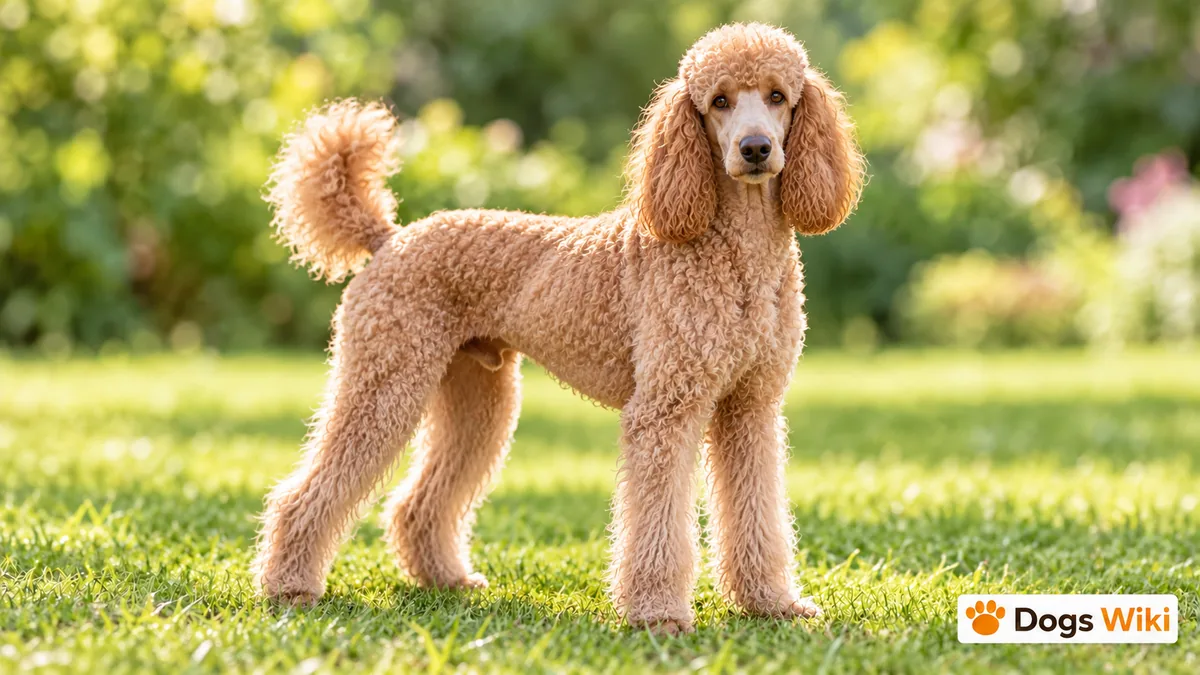
A Poodle is a highly intelligent Non-Sporting Group breed originally developed in Germany, and later refined in France, as a water retriever for hunters before becoming among the most recognizable companion and show breeds in the world.
This guide covers where the breed originated, its temperament, how big Poodles get, how long they live, the health problems they are prone to, grooming, how much exercise they need, how easy they are to train, what to feed them, the pros and cons of owning one, and what else people ask. Read together, those sections show what a Poodle is like to live with, so you can decide whether the breed fits your household.
What Is a Poodle and Where Did the Breed Originate?
A Poodle belongs to the American Kennel Club’s Non-Sporting Group, a catch-all category for breeds that don’t fit neatly into the other six. Despite its strong association with France, the breed’s origins trace back to Germany, where it was developed as a water retriever, and the name itself comes from the German word “pudel,” meaning “to splash in water.” French breeders later refined the Poodle and popularized it as a companion and show breed, which is where its enduring association with France comes from. The breed’s distinctive curly, low-shedding coat and consistently high trainability have kept it near the top of the AKC’s most popular breed rankings for decades.
The American Kennel Club defines the breed in its “Official Standard of the Poodle”, approved August 14, 1984, which sets out the size, coat, and temperament a Standard Poodle should have. As of September 2026, the AKC ranks the Standard Poodle 7th of 210 breeds in popularity.
Why Do Poodles Have Such an Unusual Haircut?
The show clip started as working gear. Hunters shaved the legs, hindquarters, and muzzle so a retrieving Poodle could swim freely, and left hair over the chest and joints to keep the vital organs and joints warm in cold water. Today the standard allows only a few clips in the show ring: the “Puppy” clip for dogs under a year, and the “English Saddle” or “Continental” for adults. Pet owners are free to choose a practical “sporting” or “lamb” clip with the same short length all over.
What Is a Poodle’s Temperament Like?
A Poodle’s temperament is intelligent, active, and proud, and the breed forms strong bonds with its family. The standard describes a dog with “an air of distinction and dignity peculiar to himself” and names shyness or sharpness as major faults. Poodles can be reserved or even territorial with strangers when they aren’t well socialized early, a trait that traces back to their history as an adaptable working and retrieving dog rather than a purely companion-bred breed. With consistent socialization, most Poodles are affectionate and adaptable, but this isn’t a breed that will warm up to every stranger the way some more universally outgoing breeds do.
Is a Poodle Sensitive to Its Household?
Yes. Poodles read tone of voice and household tension closely, and harsh corrections make many of them anxious or withdrawn. Calm routines suit them. Standards were bred to work alongside a hunter all day, so they want company and do poorly as backyard dogs. Toy and Miniature Poodles carry the same sensitivity in a smaller body and can become barky when underexercised or left alone for long stretches.
How Big Do Poodles Get?
Poodles come in three recognized sizes, Standard, Miniature, and Toy, but this guide covers the Standard Poodle specifically, since it’s the AKC’s primary reference size and the variety most closely tied to the breed’s original water-retrieving purpose. All three sizes share the same dense, curly coat and proportions, just scaled differently.
What Is the Average Poodle Height and Weight?
| Measure | American Kennel Club figure |
|---|---|
| Height | over 15 inches (standard) |
| Weight | 60-70 pounds (male standard), 40-50 pounds (female standard) |
| Life expectancy | 10-18 years |
Figures are from the American Kennel Club Standard Poodle breed profile, retrieved September 2026.
How Long Do Poodles Live?
Poodles live 10 to 18 years, with most falling in the 12 to 15 year range, which is long for a dog of this size. Smaller Poodle varieties live longer on average than the Standard, a pattern seen across most breeds where size and lifespan vary. Regular veterinary care and attention to the breed’s specific health risks, covered below, give a Poodle the best chance at the longer end of that range.
What Health Problems Are Poodles Prone To?
Standard Poodles are documented as being at higher risk for the following conditions.
What Is Addison’s Disease in Poodles?
Addison’s disease, or hypoadrenocorticism, is a shortage of hormones from the adrenal glands, and Standard Poodles are among the breeds most affected. Signs are vague and come and go: poor appetite, vomiting, weakness, and shaking. A sudden “Addisonian crisis” can cause collapse and is an emergency. An ACTH stimulation test, which is a blood test, confirms the diagnosis, and daily medication plus a monthly or periodic injection controls the disease for life.
What Is Sebaceous Adenitis in Poodles?
Sebaceous adenitis is an inherited inflammatory disease that destroys the oil glands in the skin. In Standard Poodles it shows up as hair loss, scaling, and a dry, brittle coat, beginning along the back and head. A skin biopsy diagnoses it. There is no cure, but oil soaks, medicated shampoos, and supplements keep most dogs comfortable. Breeders can screen breeding stock with a biopsy before the disease shows.
What Is Bloat in Standard Poodles?
Bloat, or gastric dilatation-volvulus, is a life-threatening emergency in which the stomach fills with gas and can twist. Deep-chested dogs like the Standard Poodle are at higher risk. A swollen belly, retching without bringing anything up, and restlessness mean a trip to the emergency vet at once. Preventive gastropexy surgery, often done alongside a spay or neuter, tacks the stomach in place.
What Other Health Problems Affect Poodles?
Hip dysplasia is the main orthopedic concern in the Standard, while Toys and Miniatures are more prone to slipping kneecaps and Legg-Calve-Perthes disease of the hip. Progressive retinal atrophy occurs in all three sizes and has a DNA test. Standard Poodles also have DNA tests for von Willebrand disease, a bleeding disorder, and for neonatal encephalopathy, a fatal brain disorder of young puppies. Ear infections and skin allergies round out the list and are managed with routine ear cleaning and, where needed, a change of diet.
Which Health Tests Should a Poodle Breeder Provide?
For a Standard Poodle, ask for hip results from the Orthopedic Foundation for Animals or PennHIP, an eye exam by a veterinary ophthalmologist, a sebaceous adenitis biopsy result, and DNA results for von Willebrand disease and neonatal encephalopathy. Toy and Miniature breeders should add a patella exam and a PRA DNA result. Clearances can be checked on the OFA website.
How Do You Groom a Poodle?
Poodles have a dense, curly coat that’s low-shedding, which is part of why the breed has a reputation as a good option for people sensitive to dog hair, though no dog is entirely allergen-free. That low-shedding coat comes at the cost of high grooming needs. Professional grooming roughly every four to six weeks is standard for the breed, along with frequent brushing at home, several times a week at minimum, to prevent the coat from matting between grooming appointments. Skipping regular brushing is one of the fastest ways to end up with painful mats that require a full shave-down to fix.
| Grooming task | How often |
|---|---|
| Line-brush to the skin with a slicker brush and comb | Three to four times a week |
| Professional clip and bath | Every 4 to 6 weeks |
| Clean ears and remove excess ear hair | Every 1 to 2 weeks |
| Trim nails | Every 3 to 4 weeks |
| Brush teeth | Daily, in particular for Toys and Miniatures |
How Much Exercise Does a Poodle Need?
A Poodle needs daily exercise plus consistent mental stimulation, reflecting the breed’s original role as an athletic water retriever. Standard Poodles in particular are high-energy and do well with activities like swimming, fetch, or structured dog sports, which combine physical effort with the mental engagement this intelligent breed craves. A Poodle that only gets physical exercise without any mental challenge finds its own outlets for that energy, which aren’t always ones an owner will appreciate.
Which Activities Suit a Standard Poodle?
About an hour a day of walking, running, or play keeps an adult Standard fit. Swimming and retrieving use the breed’s original skills. Poodles compete successfully in agility, obedience, rally, dock diving, and even AKC hunt tests for retrievers. Toys and Miniatures need less, around 30 minutes a day, yet they still want the same variety of mental work that keeps a Standard content. Puppies of all sizes should skip long runs and repeated jumping until their growth plates close.
Are Poodles Easy to Train?
Yes, Poodles are among the most trainable breeds, ranked second for working and obedience intelligence in Stanley Coren’s widely cited canine intelligence rankings. That trainability responds best to positive, consistent methods, and Poodles pick up new commands quickly given their intelligence, though their independent streak means they also need a reason to want to comply, not just repetition. Early socialization paired with training offsets the breed’s natural reserve around strangers.
What Should Poodle Owners Train First?
Handling comes first, because a Poodle will spend its life on a grooming table. Short, pleasant sessions touching paws, ears, and muzzle, with a treat each time, make clippers and dryers far less stressful later. Next come the usual puppy skills: house-training, a reliable recall, and settling calmly in a crate. Poodles learn bad habits as fast as good ones, so consistency from every family member matters.
What Should You Feed a Poodle?
Standard Poodles follow standard large-breed feeding guidance, and slow, controlled growth during puppyhood is important for protecting joint development in a breed already at some risk for hip dysplasia. A formula suited to the dog’s age, size variety, and activity level is the right starting point, and any breed-specific concerns are worth discussing directly with a veterinarian rather than guessing.
How Many Meals a Day Does a Poodle Need?
Standard Poodle puppies eat three meals a day until about six months, then two. Splitting the daily ration into two smaller meals, rather than one large one, is also a sensible precaution against bloat. Toy Poodle puppies need more frequent small meals, since tiny dogs can suffer low blood sugar when they go too long without food. Adults of every size do well on two measured meals.
What Are the Pros and Cons of Owning a Poodle?
Here are the main advantages and drawbacks of owning a Poodle, side by side.
| Pros | Cons |
|---|---|
| Highly intelligent and consistently ranked among the most trainable breeds | High grooming costs and time commitment, including regular professional grooming |
| Low-shedding coat, a genuine advantage for owners managing dog hair | Can be reserved or territorial with strangers without early socialization |
| Available in three sizes, offering flexibility for different living situations | Standard Poodles need substantial daily exercise and mental stimulation |
| Athletic and adaptable, well suited to dog sports and active households | Documented risk of bloat, a life-threatening emergency in deep-chested breeds |
Anyone drawn to the breed’s intelligence and low-shedding coat who finds a breeder search too much can contact Poodle-specific rescue organizations, which place adult dogs across all three size varieties fairly regularly.
What Else Do People Ask About the Poodle?
The questions below cover how much a Standard Poodle costs, how hypoallergenic the breed is, the difference between Toy, Miniature, and Standard Poodles, whether a home with kids is a good fit, and how frequently to book grooming.
How much does a Standard Poodle cost?
A Standard Poodle puppy from a breeder who health-tests for hip dysplasia and Addison’s disease costs more than one from a breeder who skips that testing, and prices vary by region, size variety, and breeder reputation. Adopting an adult Poodle through a rescue is less expensive and comes with a known adult temperament.
How hypoallergenic is the Poodle?
Poodles are widely described as hypoallergenic, but that’s not entirely accurate. No dog breed is completely allergen-free, since allergens come from dander, saliva, and urine, not just shed hair. What’s true is that Poodles shed little compared to most breeds, which means less hair and attached dander end up circulating through a home, making the breed a commonly recommended option for people with mild dog allergies.
What’s the difference between Toy, Miniature, and Standard Poodles?
Toy, Miniature, and Standard Poodles are the same breed at three different recognized sizes, sharing the same temperament, coat type, and general health profile, though smaller varieties live somewhat longer on average. Under the AKC standard, a Standard Poodle is over 15 inches at the highest point of the shoulders, a Miniature is 15 inches or under but over 10 inches, and a Toy is 10 inches or under, with weight scaling down at each size.
Is a home with kids a good fit for a Poodle?
Yes, Poodles do well with kids, in particular when they’ve been well socialized from puppyhood, though their intelligence and sensitivity mean they do best in households that handle them gently and consistently rather than roughly. As with any breed, young children and dogs should be supervised together. A Standard is sturdier around young children than a Toy.
How frequently should you book grooming for a Poodle?
Poodles need professional grooming roughly every four to six weeks to keep their curly coat from matting, along with brushing at home several times a week between appointments. This is one of the highest ongoing grooming commitments of any popular breed, and it’s a cost and time factor worth planning for before bringing a Poodle home.
Related Guides
More guides on The Dogs Wiki cover behavior, grooming, training, nutrition, and adoption.
| Guide |
|---|
| Behavior |
| Grooming |
| Training |
| Nutrition |
| Adoption |
Comments
6 responses to “Poodle: Breed Profile, Temperament, Health, and Care Guide”
[…] Poodle […]
[…] Poodle […]
[…] Poodle […]
[…] Poodle […]
[…] Poodle […]
[…] temperament and is comfortable with more individual variation. See the full Poodle guide and Goldendoodle guide for complete […]