Home → Dog Breeds → Toy Group → Pug
A Pug is a small Toy Group breed with roots going back roughly 2,000 years to China, where flat-faced toy dogs were kept and lavished with attention by Chinese emperors before spreading through Europe and eventually the world.
Famous for a wrinkled, expressive face and a stable, loving temperament, the Pug remains among the most recognizable companion breeds in existence. This guide covers where the breed originated, its temperament, how big Pugs get, how long they live, the health problems they are prone to, grooming, how much exercise they need, how easy they are to train, what to feed them, the pros and cons of owning one, and what else people ask.
What Is a Pug and Where Did the Breed Originate?
A Pug belongs to the American Kennel Club’s Toy Group and is one of the oldest dog breeds, believed to have originated in China roughly 2,000 years ago. Short-nosed toy dogs like the Pug were popular among Chinese emperors and lived genuinely lavish lives as a result, according to the AKC. The breed arrived in England around 1860 and reached the United States after the Civil War, with the AKC officially recognizing the Pug in 1885.
The American Kennel Club defines the breed in its “Official Standard of the Pug”, approved April 8, 2008, which sets out the size, coat, and temperament a Pug should have. As of September 2026, the AKC ranks the Pug 38th of 210 breeds in popularity.
What Does “Multum in Parvo” Mean for the Pug?
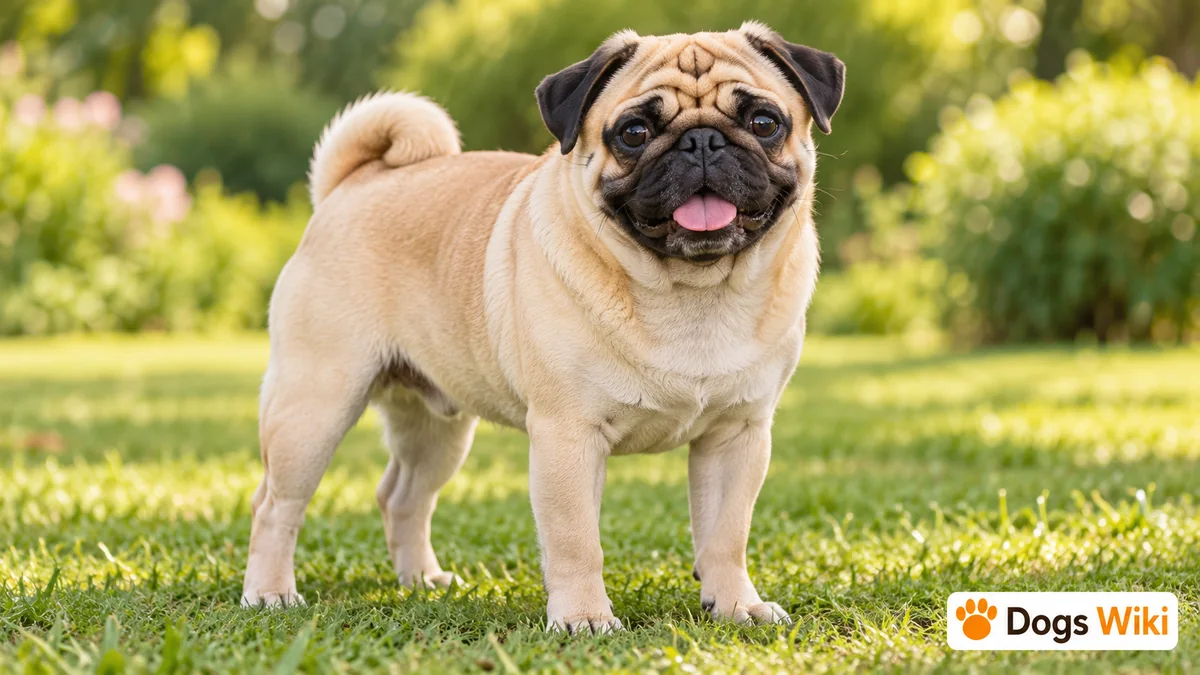
Its standard sums up the breed with the Latin phrase “multum in parvo,” meaning “a lot in a little”: a compact, square, muscular dog in a small package. Only two colors are allowed, fawn and black, and any other color is a disqualification. Fawn Pugs have a black mask, black ears, and a dark line along the back called the trace. A deep wrinkle over the nose and a tightly curled tail, ideally a double curl, complete the look.
What Is a Pug’s Temperament Like?
A Pug’s temperament is friendly, easygoing, and eager to please, and the breed genuinely loves spending time close to its people, happy to cuddle for hours. Its standard describes “an even-tempered breed, exhibiting stability, playfulness, great charm, dignity, and an outgoing, loving disposition.” Pugs are playful and mischievous, excellent with kids, other dogs, and visitors, and the breed doesn’t bark excessively, making it a reasonably good if not imposing watchdog. Pugs are also slow to mature, staying puppy-like in behavior for up to four years, which is worth knowing before bringing a Pug into a home with young children.
Do Pugs Get Separation Anxiety?
Pugs were bred for one job, keeping people company, and many follow their owners from room to room. Long days alone can lead to whining, chewing, and house-soiling. Building up time alone gradually from puppyhood, a comfortable crate, and a chew toy help. A Pug suits homes where someone is around for much of the day better than homes that are empty from morning to evening.
How Big Do Pugs Get?
Pugs are a compact, square, stocky breed with a massive round head, large globe-like eyes, deep facial wrinkles, and a tightly curled tail, all defining features of the breed’s distinctive look.
What Is the Average Pug Height and Weight?
| Measure | American Kennel Club figure |
|---|---|
| Height | 10-13 inches |
| Weight | 14-18 pounds |
| Life expectancy | 13-15 years |
Figures are from the American Kennel Club Pug breed profile, retrieved September 2026.
How Long Do Pugs Live?
Pugs live 13 to 15 years, a few years longer than average for dogs generally, reflecting the pattern in which small breeds outlive large ones. Given the breed’s real brachycephalic health risks, regular veterinary care and attentiveness to heat and breathing issues matter considerably for a full, comfortable life.
What Health Problems Are Pugs Prone To?
Pugs are documented as being at higher risk for the following conditions, most connected to the breed’s flat-faced build.
What Is Brachycephalic Obstructive Airway Syndrome in Pugs?
Brachycephalic obstructive airway syndrome, together with stenotic nares, or pinched nostrils, is the breed’s defining health challenge. Behind it sits a shortened skull that leaves too much soft tissue for too little space: an overlong soft palate, a narrow windpipe, and a crowded throat. Snoring, snorting, gagging, and tiring quickly on walks are common, while collapse in heat is an emergency. Surgery to open the nostrils and trim the palate improves breathing in many Pugs, and keeping the dog lean helps every case.
What Eye Problems Affect Pugs?
Corneal ulceration is common because the breed’s prominent, exposed eyes are easily scratched and don’t always close fully during sleep. Squinting, tearing, or a cloudy spot needs a vet the same day. Pigmentary keratitis, a brown pigment that spreads across the cornea, and dry eye also occur. Proptosis, in which the eyeball is pushed out of its socket after a knock or a hard pull on a collar, is an emergency.
What Is Pug Dog Encephalitis?
Pug Dog Encephalitis, a form of necrotizing meningoencephalitis, is a rare but fatal inflammatory brain disease strongly associated with the breed. It causes seizures, circling, and eventually blindness and coma. Researchers have not fully explained its cause, but a genetic risk test developed at the University of California, Davis, estimates a dog’s susceptibility, and some breeders use it when planning litters.
What Other Health Problems Affect Pugs?
Skin fold dermatitis develops when the deep facial wrinkles trap moisture and bacteria, and regular cleaning prevents it. Patellar luxation, a slipping kneecap, and Legg-Calve-Perthes disease, a breakdown of the top of the thighbone, affect the legs. Screw tails are linked to hemivertebrae, malformed spinal bones, and some older Pugs develop a slowly progressive weakness of the back legs linked to spinal problems.
Which Health Tests Should a Pug Breeder Provide?
Ask for a patella evaluation, an eye exam by a veterinary ophthalmologist, and, where available, the PDE genetic risk result for both parents. Watching the parents walk and breathe on a warm day is a practical test in itself: open nostrils and quiet breathing are worth paying for. In the UK, a respiratory function grading scheme for Pugs gives breeders a formal airway score.
How Do You Groom a Pug?
Pugs have a short, smooth coat that sheds regularly despite its length, and weekly brushing manages loose hair. The bigger grooming priority is the facial wrinkles, which need cleaning with a damp cloth at least once a week to prevent the skin fold infections the breed is prone to, along with routine nail trims and daily dental care.
| Grooming task | How often |
|---|---|
| Brush with a rubber mitt or bristle brush | Weekly, more during spring and fall shedding |
| Clean and dry the nose wrinkle | At least weekly, daily in humid weather |
| Trim nails | Every 3 to 4 weeks |
| Brush teeth | Daily |
| Bath | Every 1 to 2 months |
How Much Exercise Does a Pug Need?
A Pug needs only modest exercise, and the breed must be kept primarily indoors, since its brachycephalic build makes both hot and cold temperatures genuinely risky rather than just uncomfortable. Short walks and indoor play are enough to meet the breed’s physical needs, and any sign of excessive snorting, wheezing, or labored breathing during activity is a signal to stop and let the dog rest.
How Should Pug Exercise Change in Summer?
Walk in the early morning and after dark, and keep outings short on warm, humid days. Use a harness rather than a collar to protect the windpipe and the eyes, since pressure on the neck raises pressure behind the eyes as well. Carry water, stop in the shade, and never push a Pug that lags behind. On hot days, indoor games and sniffing puzzles give enough activity without the heat risk.
Are Pugs Easy to Train?
Pugs are smart and willing to please, but the breed also has a stubborn, tenacious streak that can make training take real patience. Positive reinforcement with food rewards works well given the breed’s food motivation, though owners need to watch treat quantities carefully given the Pug’s tendency toward weight gain.
What Should Pug Training Focus On?
House-training comes first, and it can take several months with a Pug. Use a crate, a fixed routine, and praise for every success outdoors; together they speed things up considerably, and patience matters more than any single technique. Next come polite greetings and a reliable “leave it,” which stops a Pug from eating things it shouldn’t on walks. Pugs love to perform, so trick training is an easy way to keep sessions fun.
What Should You Feed a Pug?
Pugs love food and become overweight easily, which directly worsens the breed’s existing breathing difficulties, so careful portion control matters more for this breed than for most. A small-breed formula fed in measured amounts, around half a cup twice daily adjusted for the individual dog, is a reasonable starting point, with a veterinarian helping adjust the exact amount.
What Are the Pros and Cons of Owning a Pug?
Here are the main advantages and drawbacks of owning a Pug, side by side.
| Pros | Cons |
|---|---|
| Friendly, affectionate, genuinely easygoing temperament | Significant documented brachycephalic breathing and heat-tolerance risks |
| Excellent with kids, other pets, and visitors | Prone to weight gain, which worsens breathing difficulties |
| Low exercise needs, well suited to apartment living | Requires regular wrinkle cleaning to prevent skin infections |
| Sturdy build for a toy breed, less fragile than some | Slow to mature, staying puppy-like for years |
People who love the breed’s charming temperament but would rather not search for a breeder can contact Pug rescue organizations, which place adult dogs regularly.
What Else Do People Ask About the Pug?
The questions below cover how much a Pug costs, whether a family home is a good fit, why snoring is so common in the breed, what the brain disease known as PDE in the Pug is, and how safe hot weather is for a Pug.
How much does a Pug cost?
Pug prices vary by region, bloodline, and breeder reputation, and a puppy from a breeder who screens for eye, knee, and airway health costs more than one that doesn’t. Adopting an adult Pug through a rescue is a lower-cost alternative.
Is a family home a good fit for a Pug?
Yes, Pugs are widely regarded as excellent family dogs, known for being friendly, easygoing, and good with children of most ages, though their tendency to stay puppy-like and boisterous for years means young children should still be supervised during play.
Why is snoring so common in the Pug?
Pugs snore, snort, and snuffle because of brachycephalic obstructive airway syndrome, a set of structural airway issues caused by the breed’s shortened muzzle and narrowed nostrils. These sounds are typical for the breed, but labored breathing, in particular at rest or after minimal activity, is worth a veterinary visit rather than dismissing as normal.
What is the brain disease known as PDE in the Pug?
Pug Dog Encephalitis is a rare but fatal inflammatory disease of the brain strongly associated with the breed, causing seizures, circling, and eventually blindness and coma as it progresses. Its cause is not fully understood, and while a genetic risk test exists, it cannot say for certain which dogs will fall ill. The disease remains uncommon relative to the breed’s other, more manageable health risks.
How safe is hot weather for a Pug?
Hot weather is risky for Pugs given their brachycephalic build, which makes it harder for the breed to cool itself effectively through panting compared to dogs with a normal muzzle length. Exercise should be limited to cooler parts of the day, and a Pug should never be left in a hot car or unshaded area, even briefly.
Related Guides
More guides on The Dogs Wiki cover behavior, grooming, training, nutrition, and adoption.
| Guide |
|---|
| Behavior |
| Grooming |
| Training |
| Nutrition |
| Adoption |